

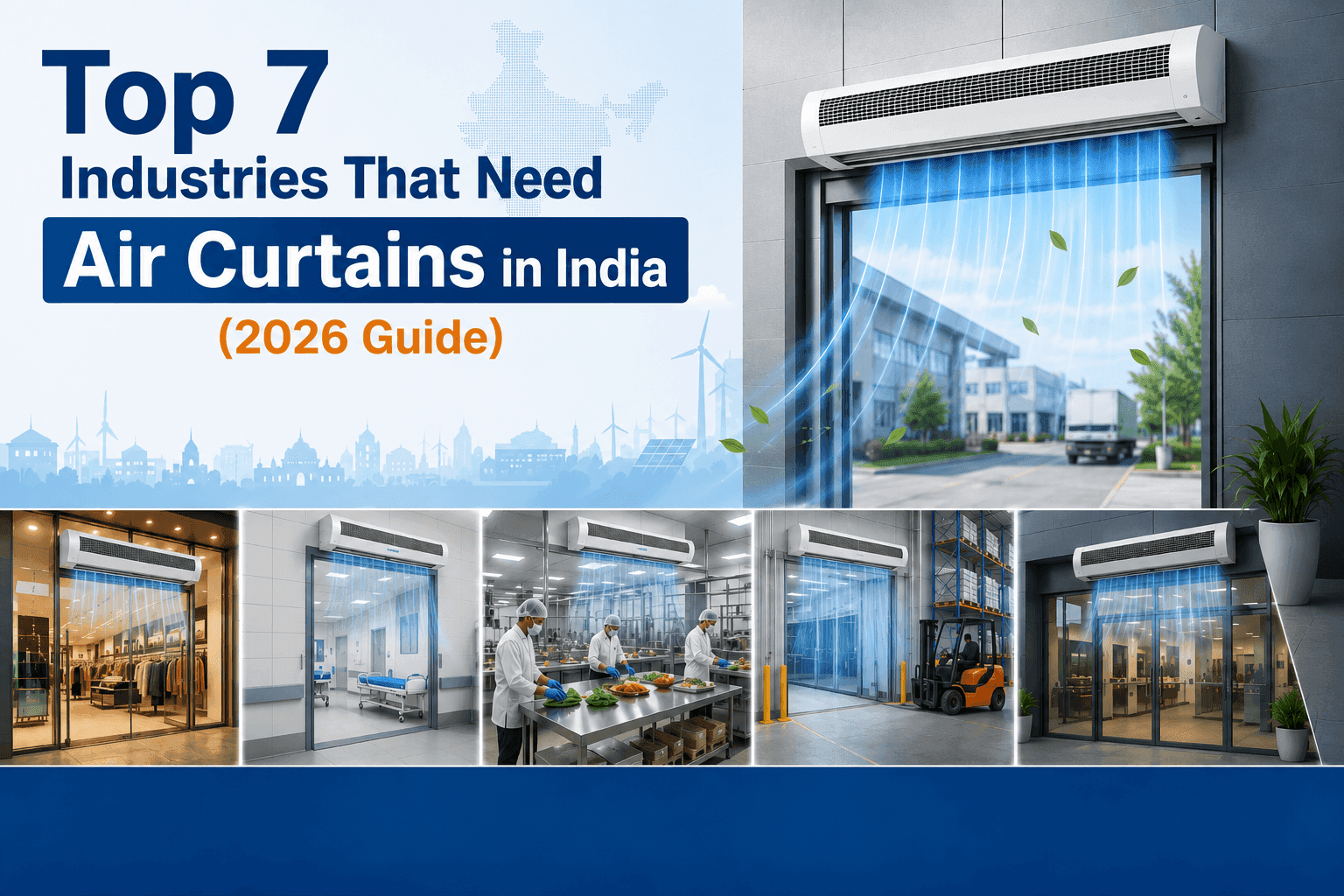
Top 7 Industries That Need Air Curtains in India (2026 Guide)
Mitzvah Team
Published: July 21, 2026Updated: July 21, 2026
Discover the top 7 Indian industries that benefit from air curtains for better hygiene, energy efficiency, temperature control, and pest prevention. Learn why air curtains are essential for factories, hospitals, retail stores, and more.
Every time a factory shutter rolls up or a restaurant door swings open, conditioned air escapes and dust, insects, and outside heat rush in. For Indian businesses operating in high temperatures, dusty conditions, and high-footfall entrances, this isn't a minor inconvenience it's a recurring drain on comfort, hygiene, and HVAC efficiency. Frequently used doorways in warehouses, kitchens, and production floors are a common source of unwanted heat exchange and pest entry.
This is where an air curtain becomes relevant. In this guide, you'll discover which industries that need air curtains in India benefit most, how air curtains support hygiene and energy efficiency, and what factors businesses should consider when selecting the right industrial air curtain solutions.
What Is an Air Curtain and How Does It Work?
An air curtain is a device installed above or beside a doorway that projects a steady stream of air downward or across the opening. This creates an invisible air barrier that separates indoor and outdoor environments without blocking movement of people, vehicles, or goods.
When installed and calibrated correctly, an air curtain can help reduce the exchange of conditioned indoor air with outdoor air, and may help limit the entry of dust, flying insects, and airborne pollutants through open doorways.
An air curtain is a device mounted above a doorway that blows a controlled stream of air across the opening, forming an air barrier. This can help reduce conditioned air loss and limit dust, insects, and pollutants from entering. It's commonly used in factories, warehouses, restaurants, and retail entrances.
Top 7 Industries That Need Air Curtains in India
1. Manufacturing and Factory Facilities Need Industrial Air Curtains
Factories often have large shutter-style entrances that stay open for extended periods to allow forklifts, trolleys, and workers to move materials in and out. This constant movement creates a direct path for dust, heat, and outdoor air to enter production areas, increasing the load on ventilation systems.
In manufacturing facilities, air curtains are installed at large entry points and loading areas to reduce dust infiltration and limit heat exchange during frequent door use. This supports a more stable indoor environment for production processes and worker cofort.
Key Benefits for This Industry
Reduced dust entering production zones
Support for temperature-sensitive processes
Improved comfort for workers near open bays
Common Applications: Shutter entrances, loading docks, and material-handling bays.
What Businesses Should Consider: Doorway width, shutter height, and the volume of daily vehicle or foot traffic when selecting an industrial air curtain solution.
2. Warehouses and Logistics Centres
Warehouses and distribution centres, especially in India's growing e-commerce sector, have loading bays that open and close frequently throughout the day. Each opening allows dust, humidity, and outdoor temperature to affect stored inventory, and in temperature-sensitive storage areas, this can increase refrigeration workload.
Air curtains for warehouses are typically installed at loading dock doors and shipping bays to reduce dust intrusion and limit temperature fluctuation as goods move in and out. This is particularly useful in logistics centres with high door-opening frequency.
Common Applications: Loading docks, dispatch bays, and cold-storage-adjacent zones.
What Businesses Should Consider: Traffic frequency and whether the facility includes temperature-controlled zones requiring stronger airflow performance.
3. Restaurants and Commercial Kitchens
Restaurant entrances and kitchen doorways are opened constantly during service hours, creating opportunities for flying insects and outdoor dust to enter food preparation and dining areas. Maintaining hygiene standards while keeping doors accessible to customers and staff is an ongoing challenge.
In restaurants, air curtains for restaurants are installed at customer entrances and kitchen or delivery doors to help reduce insect entry and support hygiene efforts. They are commonly recommended by commercial air curtain suppliers in India as a complementary hygiene measure.
It's important to note that air curtains support hygiene and pest-control efforts but do not replace proper sanitation practices or dedicated pest-control systems.
Common Applications: Main entrances, kitchen service doors, and delivery entry points.
4. Retail Stores and Shopping Centres
Retail outlets and shopping centres see continuous customer footfall, which means entrance doors are rarely fully closed. This constant opening affects indoor comfort and increases strain on HVAC systems trying to maintain a consistent indoor temperature.
Commercial air curtains at retail entrances help maintain indoor comfort by reducing the exchange of conditioned air with outside temperatures during continuous customer movement, supporting more efficient HVAC operation.
What Businesses Should Consider: Entrance width, footfall volume, and aesthetic integration with storefront design.
5. Hospitals and Healthcare Facilities
Hospitals and clinics require carefully controlled indoor environments, with high foot traffic through entrances, emergency bays, and pharmacy counters. Outdoor dust and temperature swings can affect indoor air quality expectations in these sensitive settings.
In healthcare facilities, air curtains are used at high-traffic entrances to help reduce dust and outdoor air infiltration, supporting a more controlled indoor environment alongside existing facility protocols.
Air curtains in healthcare settings are a supporting environmental-control measure and do not replace specialised infection-control systems or dedicated healthcare HVAC design.
6. Cold Storage and Food Processing Units
Cold storage facilities and food processing units depend on stable internal temperatures. Every time a cold room or processing area door opens, warm outside air enters, increasing refrigeration workload and creating conditions for condensation and dust.
In cold storage and food processing environments, air curtains help limit warm air infiltration when doors open, supporting more stable internal temperatures and reducing dust and insect entry near processing zones.
Common Applications: Cold room entrances, processing floor doorways, and dispatch areas within food units.
7. Hotels and Hospitality Businesses
Hotels manage multiple entry points lobby doors, restaurant entrances, banquet halls, and kitchen service areas — each with different traffic patterns. Guests expect consistent indoor comfort, while back-of-house areas need dust and insect control.
In hotels, air curtains are installed at lobby entrances, restaurant doorways, and kitchen service points to support guest comfort and hygiene while allowing doors to remain open for smooth guest and staff movement.
Common Applications: Main lobby entrances, banquet hall doors, and hotel kitchen service entries.
Why Indian Businesses Use Air Curtain Solutions
Air curtains, when properly selected and installed, can offer several operational advantages:
Can help reduce the exchange of indoor and outdoor air at frequently used entrances
May support energy efficiency by reducing HVAC or refrigeration workload
Can contribute to improved indoor comfort for staff and customers
May help reduce the entry of dust and outdoor pollutants
Can support insect-control efforts alongside other measures
May contribute to better hygiene in food-service and healthcare settings
Can support smoother operation of high-traffic entrances without requiring doors to stay closed
These benefits depend on correct sizing, installation height, and airflow calibration for each specific application.
How to Choose the Right Air Curtain for Your Industry
Doorway Size
Width and height determine airflow volume and unit specification required for full doorway coverage.
Installation Height
The distance between the unit and the floor affects how effectively the air barrier reaches ground level.
Traffic Frequency
Entrances with constant movement, like warehouse docks or restaurant doors, may need higher-duty units than occasional-use doors.
Indoor and Outdoor Conditions
Temperature differences, dust levels, humidity, and insect activity all influence the airflow strength and design needed.
Airflow and Performance
Performance specifications should be matched to doorway dimensions and the environmental challenge at hand, not chosen generically.
Noise and Energy Consumption
Operational comfort and running costs matter, especially in customer-facing or staff work areas.
Maintenance and Technical Support
Reliable access to servicing and spare parts from industrial air curtain manufacturers ensures long-term performance.
Choosing the right air curtain involves matching the unit to doorway dimensions, installation height, and traffic frequency, while accounting for indoor-outdoor temperature differences, dust, and insect exposure. Application-specific airflow performance is essential for effective results.
Industrial vs Commercial Air Curtains: What Is the Difference?
Factor | Industrial Air Curtains | Commercial Air Curtains |
Application | Factories, warehouses, cold storage | Retail, restaurants, hotels, offices |
Door Size | Large shutters, loading bays | Standard entrance doors |
Traffic Volume | Heavy vehicle and material movement | High foot traffic |
Operating Environment | Dust, heat, industrial conditions | Customer-facing, comfort-focused |
Performance Needs | High-velocity, heavy-duty airflow | Moderate airflow, quieter operation |
Neither category is inherently better — the right choice depends entirely on the doorway, traffic pattern, and environmental conditions of the specific facility.
What Experts Recommend When Selecting Air Curtains
Facility and HVAC professionals generally recommend starting with an assessment of the doorway's actual usage pattern rather than its size alone. A small but constantly used doorway connecting a conditioned space to a dusty or hot outdoor area often benefits more from a well-calibrated air curtain than a large, rarely opened entrance.
Original Insight: The highest-value application for an air curtain is not necessarily the largest doorway. In many Indian facilities, frequently opened doors connecting conditioned indoor spaces with hot, dusty, or insect-prone outdoor areas may present the strongest opportunity for improving environmental control.
Conclusion
Air curtains offer a practical way for Indian businesses to manage the challenges of frequently used entrances from dust and insects to conditioned air loss and temperature fluctuation. Across the industries that need air curtains in India, including manufacturing, warehousing, restaurants, retail, healthcare, cold storage, and hospitality, the underlying need is the same: maintaining a controlled indoor environment without disrupting the flow of people, vehicles, or goods.
Selecting the right unit depends on doorway size, traffic patterns, and environmental conditions specific to each facility. Working with experienced industrial air curtain manufacturers ensures the solution is matched correctly to the application.
Looking for the right air curtain solution for your factory, warehouse, restaurant, or commercial facility? Explore Mitzvah air curtain solutions and consult experienced air curtain manufacturers in India to identify the right solution for your application.
FAQs
Industries with frequently used entrances exposed to dust, heat, or insects benefit most including manufacturing, warehousing, restaurants, retail, healthcare, cold storage, and hospitality businesses across India.
Yes. Factories with large shutter entrances and constant material movement can use industrial air curtains to help reduce dust infiltration and support more stable indoor temperatures during production.
Air curtains can help reduce conditioned air loss at open doorways, which may support HVAC efficiency. Actual savings depend on installation quality, doorway usage, and environmental conditions, and cannot be guaranteed.
No. Air curtains are not a complete replacement for doors where security, fire safety, or access control is required. They work best alongside doors, not instead of them.
Consider doorway size, installation height, traffic frequency, indoor-outdoor temperature differences, and specific environmental challenges like dust or insects before selecting a unit.
Yes. Warehouses with frequent loading bay activity can use air curtains to help reduce dust entry and limit temperature fluctuation, particularly near temperature-sensitive storage zones.
Yes. Restaurants commonly install air curtains at entrances and kitchen doors to support hygiene and reduce insect entry, alongside standard sanitation and pest-control practices.