

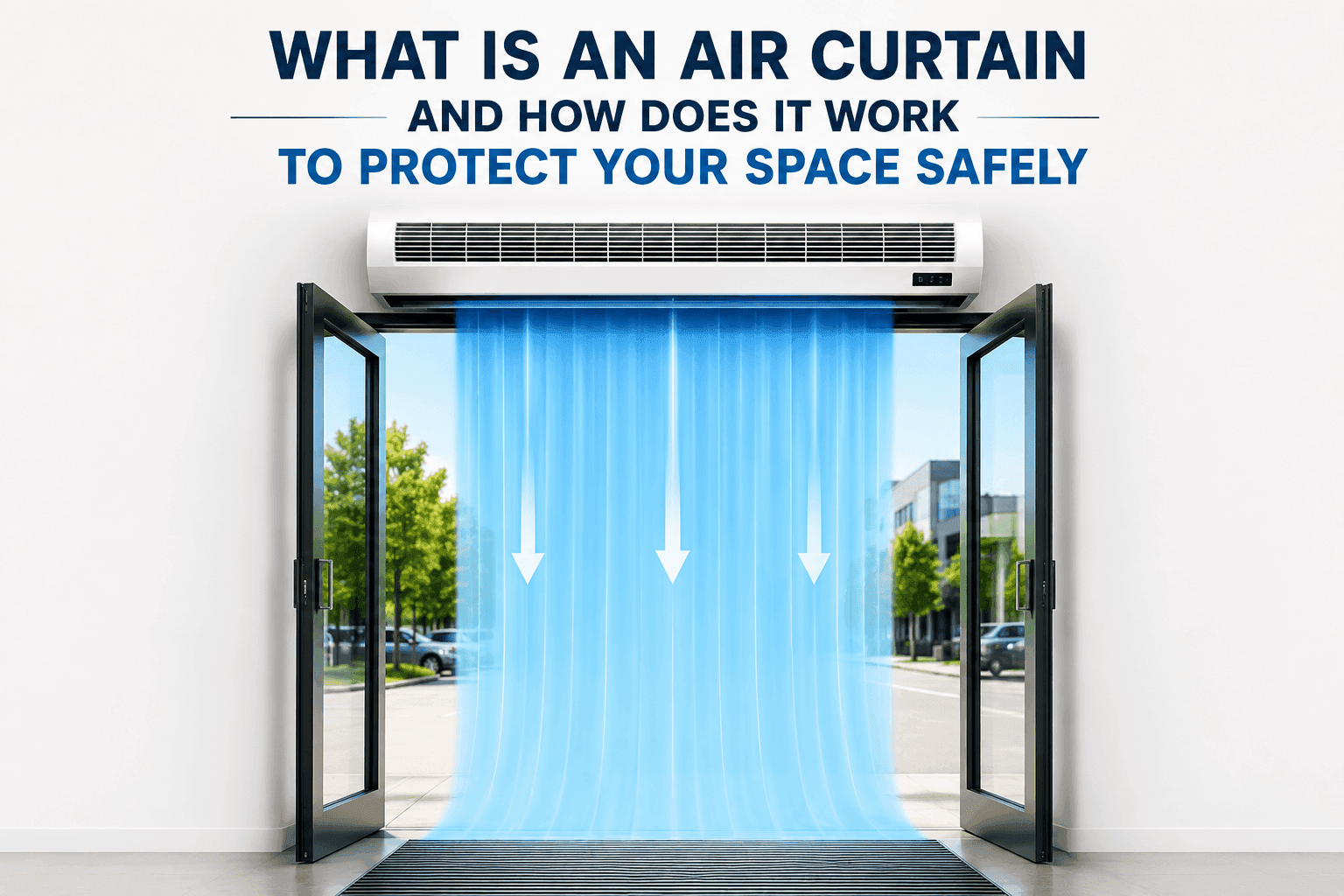
What Is an Air Curtain and How Does It Work to Protect Your Space Safely
Published: July 18, 2026Updated: July 18, 2026
Understand how an air curtain works to improve airflow, reduce energy loss, protect your environment, enhance comfort, maintain temperature, block drafts, and create a safer, more efficient indoor space for homes and businesses alike.
You know that blast of air you feel when you walk into a mall or a big store? That's an air curtain. It's a device that pushes a steady stream of air across an open doorway, making an invisible “wall” of air. This keeps out dust, bugs, and heat while your door stays wide open. Here's how it works and what to know before you buy one.
Key Takeaways
● What it is: A unit fixed above your door that blows air across the entrance.
● How it works: A fan pulls in air, speeds it up, and pushes it down to make an air barrier.
● Why it helps: Cuts down dust and insects, keeps your cool or warm air inside, and eases the load on your AC.
● Where you'll see them: Shops, restaurants, warehouses, hospitals, cold storage, and more.
● Before buying: Pick a size that fits your doorway and matches how high it'll be mounted.
What Is an Air Curtain?
An air curtain is a fan-powered unit fixed above or beside a doorway. It blows a strong, steady stream of air across the opening to keep the inside and outside apart. In short, it lets your door stay open without letting the outside in.
You'll find them in shops, restaurants, warehouses, and hospitals. They team up nicely with your AC and are often placed above automatic doors at busy entrances. That moving wall of air blocks most of the dust, insects, and outdoor air from drifting inside so your space stays cleaner and more comfortable.
How Does an Air Curtain Work?
An air curtain works by pulling in air, speeding it up with a fan, and blasting it down across your doorway. That fast-moving air forms an invisible barrier.
Here's what happens, step by step:
● It pulls in air — The unit takes in air from the room around it.
● A fan gets to work — An electric motor spins a fan that pressurises that air.
● The air speeds up — The air is pushed faster as it heads toward the outlet.
● It shoots the air out — A narrow slot fires the air downward at high speed.
This constant jet of air acts like a shield. Dust and bugs struggle to get through, and your cool or warm air stays put—yet people, trolleys, and even vehicles pass through without a hitch.
What Are the Benefits of an Air Curtain?
Here's what an air curtain can do for your business:
● Less dust — It blocks a lot of the dust that would blow in through an open door.
● Fewer fumes and pollutants — Smoke and street dirt get pushed away.
● Steadier temperature — Your cool or warm air doesn't escape as easily.
● Lighter load on your AC — Since less air escapes, your AC doesn't have to work as hard.
● Fewer flying insects — The moving air keeps most bugs out.
● Easy in and out — No door to push open—people just walk through.
● Great for busy doors — Perfect for entrances with people coming and going all day.
One honest note: an air curtain reduces dust, bugs, and air loss it doesn't fully stop them. How well it works comes down to the right size and a proper fit.
Where Are Air Curtains Used?
You'll spot air curtains in all kinds of places:
● Shops and malls — Welcoming open doors, but the AC stays inside.
● Restaurants and kitchens — Keep bugs out and control heat and smells.
● Hotels and resorts — Keep the lobby comfy even at busy front doors.
● Hospitals and clinics — Help keep indoor air cleaner.
● Warehouses and factories — Handle dust and heat at big loading doors.
● Cold storage — Hold in those low temperatures.
● Airports and offices — Keep large public entrances comfortable.
Different places need different units, though. A cold storage door needs far stronger airflow than a small shop entrance, and a tall warehouse door needs a much more powerful unit than a restaurant door.
Air Curtain vs Traditional Door: Which Is Better?
Here's a straight side-by-side comparison:
Feature | Air Curtain | Traditional Door | Best For |
Ease of movement | Just walk through, no hands | You have to open and close it | Air Curtain |
Dust reduction | Cuts dust while open | Blocks dust only when shut | Depends on use |
Temperature control | Slows air loss while open | Seals fully when shut | Door (when closed) |
Insect control | Keeps most bugs out | Blocks bugs when shut | Depends on use |
Accessibility | Fully open, nothing in the way | Can block trolleys and crowds | Air Curtain |
Busy entrances | No hold-ups | Slows people down | Air Curtain |
Here's the thing: an air curtain isn't always a full replacement for a real door. A lot of businesses use both—the door to lock up and seal tight when closed, and the air curtain to protect the space during busy hours. Together, they usually work best.
How to Choose the Right Air Curtain
Follow these simple steps to pick the right one.
Step 1 — Measure Your Doorway
Measure how wide and tall your door opening is. The air curtain needs to be at least as wide as the doorway so its air covers the whole opening. Too small, and air and dust slip through the gaps.
Step 2 — Check How High It'll Be Mounted
The higher up the unit sits, the more powerful it needs to be to reach the floor with enough force. So match the unit's rated height to where you'll actually fix it.
Step 3 — Think About Where You'll Use It
Needs change from place to place. Shops and restaurants do fine with medium airflow. Warehouses and factories need stronger airflow for big doors and dust. Cold storage needs high-power units to keep the temperature locked in.
Step 4 — Compare Airflow and Performance
Look at:
● Airflow — how much air it moves
● Air speed — how fast the air hits the floor
● Motor quality — how tough and reliable it is
● Noise — matters a lot near customers
● Power use — since it runs for long hours
Step 5 — Compare Air Curtain Price in India
Before you buy an air curtain, look at the full value—not just the sticker price. Air curtain price depends on the size, airflow, motor, whether it heats the air, the brand, and the features. When you shop for an air curtain in India, weigh how well it performs and lasts against what it costs.
Air Curtain Price in India: What Affects the Cost?
A few things decide the air curtain price in India:
● Size — Bigger doors need bigger, pricier units.
● Airflow — Stronger models cost more.
● Motor — Heavy-duty motors add to the price.
● Heated or not — Heated air curtains cost more than plain ones.
● Mounting height — Taller mounting needs a stronger, costlier unit.
● Brand and build — Trusted brands and solid builds cost more.
● Energy use — Efficient units may cost more now but save later.
● Extra features — Remotes, sensors, and speed settings push the price up.
Don't just grab the cheapest one. Think about how well it performs, how long it'll last, how much upkeep it needs, and how much power it uses. Spending a little more upfront often means lower bills and a longer life.
Visual Content Recommendations
● How-it-works infographic — Under the “How Does an Air Curtain Work?” section. Show a cutaway of a doorway with the intake, fan, and downward air. Alt text: “Diagram showing how an air curtain works by blowing air across a doorway.”
● Airflow diagram — In the definition section. Side view of the air forming a barrier. Alt text: “Labelled air curtain airflow barrier over a commercial door.”
● Comparison table graphic — Already above. Alt text: “Air curtain vs traditional door comparison table.”
● Buying checklist — Near the buying guide. A simple 5-point checklist card. Alt text: “Checklist for choosing the right commercial air curtain.”
Conclusion
An air curtain is a device that blows a steady stream of air across your doorway to make an invisible barrier keeping out dust, bugs, and letting less of your cool or warm air escape. It works by pulling in air, speeding it up, and pushing it out fast, which takes some load off your AC too. The real trick is picking the right size for your door and your space. And when you compare air curtain price in India, go for quality and durability over the cheapest option it pays off in the long run.
FAQs
An air curtain makes an invisible wall of air across an open door. This wall keeps the inside and outside apart, so less dust, fewer bugs, and less of your cool or warm air escape while people and goods still pass through freely.
It pulls in air, speeds it up with a fan and motor, then blasts it across the doorway. That fast air forms a moving barrier that blocks dust, bugs, and outside air from getting in.
If your entrance stays busy all day, then yes—it's usually worth it. It eases the load on your AC, keeps things comfortable, and cuts dust and bugs while your door stays open. Just make sure you pick the right size for the job.
An AC cools or heats the air in a room. An air curtain doesn't—it just makes an air barrier at the door to keep air from escaping. They work as a team: the air curtain keeps your cool air in, so your AC runs easier.
It depends on the size, airflow, motor, whether it heats the air, the brand, and the features. Prices vary a lot, so it's best to ask suppliers for current quotes and compare models on quality—not just price.
It cuts down dust a lot, but it can't stop it completely. How well it works depends on the right size, mounting height, and airflow. For very dusty spots, go with a stronger unit that fits your doorway.