

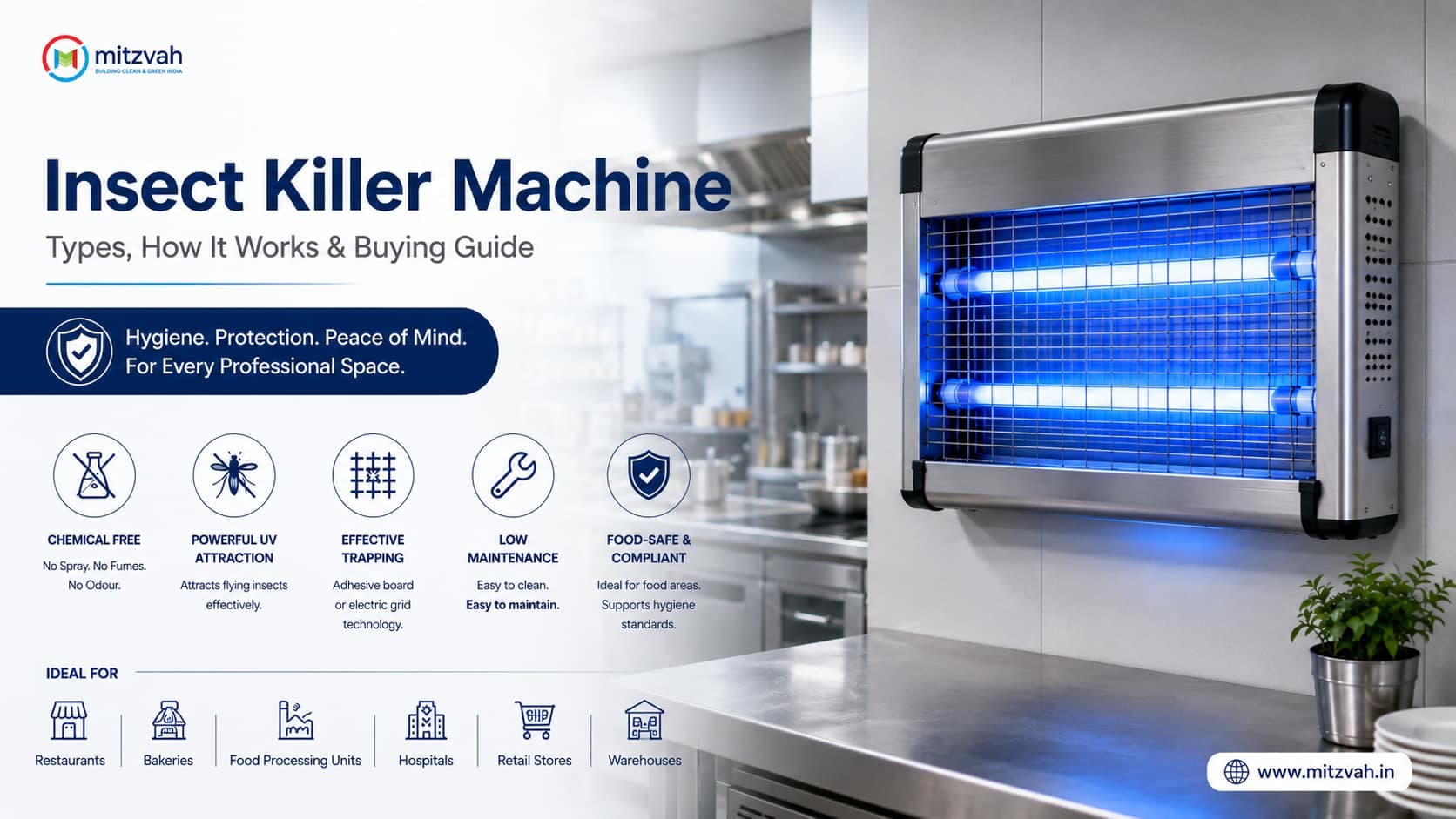
Insect Killer Machine: Types, How It Works & Buying Guide
Mitzvah Team
Published: August 20, 2026Updated: August 20, 2026
Chemical-free insect killer machines for restaurants & hygienic commercial kitchens — UV, electric grid & wall-mounted types explained, plus buying tips.
Flies and mosquitoes entering a kitchen, dining area, or food-processing unit are more than a nuisance — they're a direct hygiene risk and a common reason businesses fail food-safety inspections. An insect killer machine solves this without spraying chemicals near food, which is why an electric insect killer or UV insect killer has become a standard fixture in restaurants, bakeries, retail stores, and warehouses across India. This guide covers how insect killer machines work, the different types available — including the flying insect killer machine format most commercial kitchens use — and how to choose the right insect killer machine for restaurant or commercial use.
How Does an Insect Killer Machine Work?
An insect killer machine works by emitting ultraviolet (UV) light that flying insects are naturally drawn to. This is the same principle behind every UV insect killer light and insect killer lamp on the market. Once the insect approaches the unit, it is trapped — either stuck to a replaceable adhesive board, or neutralised on an electrically charged grid, depending on the model.
The UV lamp — sometimes marketed as an insect killer tube light or ultraviolet light insect killer — runs continuously and silently, so the unit works around the clock without producing any smell or noise that would disturb customers or staff. Because there's no spray or fogging involved, an electric insect killer machine is considered safe to run in areas where food is prepared or served, which is exactly how insect killer machines earn their place in food-service settings where chemical sprays and foggers aren't an option.
Types of Insect Killer Machines
Insect killer machines and flying insect killer machines are built in a few distinct formats, each suited to a different kind of space. The table below breaks down the main types.
Type | How It Traps Insects | Best Suited For |
Wall-Mounted Insect Killer | UV light draws insects onto an adhesive board or grid fixed to the wall | Kitchens, back-of-house areas, narrow spaces |
Ceiling-Suspended Insect Killer | Hangs from the ceiling for wider, 360° coverage | Large dining halls, food courts, warehouses |
Electric Grid Insect Killer | Insects are drawn in and neutralised on an electrically charged grid | High-insect-load areas needing continuous, chemical-free control |
Adhesive Board Insect Killer | Insects stick to a replaceable glue board — no electric current involved | Areas needing silent, low-maintenance operation near food |
Designer Insect Killer | Same UV-and-trap mechanism in a slimmer, décor-friendly casing | Customer-facing areas — retail counters, hotel lobbies, cafés |
Most commercial buyers choose between the electric grid and adhesive board versions. An electric grid insect killer generally suits high-traffic, high-insect-load areas that need continuous control, while an adhesive-board insect and mosquito killer is preferred in food-handling zones where operators want to avoid any electrical discharge near open food.
Where Are Insect Killer Machines Used?
A commercial insect killer is most commonly installed in food and hospitality environments, though the same kitchen insect killer technology is used well beyond kitchens:
• Restaurants, bakeries, and cafés — an insect killer machine for restaurant use is typically placed near kitchen entrances and food-prep zones
• Food processing and packaging units — where insect contamination directly affects compliance
• Hospitals and pharma facilities — where hygiene standards are strict and chemical sprays aren't an option
• Retail stores and supermarkets — placed discreetly near stockrooms or entrances
• Warehouses and cold storage — larger ceiling-suspended units for wide-area coverage
For food businesses in particular, a hygiene insect killer also supports FSSAI compliance: inspectors specifically look for active insect-control measures in food-handling areas, and a chemical-free UV trap is one of the few control methods considered compliance-friendly, since it doesn't risk chemical contamination of food surfaces.
Mitzvah has covered this compliance angle in more depth in a separate guide on how air curtains ensure FSSAI hygiene compliance for restaurants, which pairs well with insect control as part of a complete entry-point hygiene strategy.
How to Choose the Right Insect Killer Machine
A few practical factors decide which model — and which type of electric insect killer — is right for your space:
• Coverage area — larger kitchens or halls need ceiling-suspended or multiple wall-mounted units, not a single small unit
• Mount type — wall-mounted for tight spaces, ceiling-suspended for open floor plans
• Trap mechanism — adhesive board for food-adjacent zones, electric grid for back-of-house or storage areas
• Maintenance access — boards and trays should be easy to reach and replace without shutting down the unit for long
• Indoor vs. semi-outdoor rating — units near open-air entrances need a rating suited to that exposure
As a reference point, Mitzvah's Metal Fly Catcher — a glue-pad based wall-mounted unit designed for restaurants, hotels, and offices — is priced from roughly ₹4,200 + GST, giving a useful benchmark when comparing options.
Choosing the Right Fit for Your Business
Whether it's a compact wall-mounted electric insect killer for a small kitchen or a ceiling-suspended electric grid insect killer for a warehouse, the right insect killer machine comes down to matching the trap mechanism and coverage to your specific space.
Mitzvah's insect killer range — spanning wall-mounted, ceiling-suspended, electric grid, adhesive board, and designer models — is built for exactly this kind of commercial, food-safe use.
Many food-service businesses also pair their insect killer machine with air curtains at entrances, combining both to keep dust, heat loss, and flying insects out at the door — a common setup Mitzvah supplies as a complete package.
Explore Mitzvah's insect killer machine range or get a customised quote for your space to find the right fit for your business.
FAQs
It uses UV light to attract flying insects, then traps them using either an adhesive board or a controlled electric grid, depending on the model — no chemicals or sprays are involved.
An electric insect killer neutralises insects on a charged grid the moment they land, while a glue-board model simply traps them on a sticky surface — both use the same UV-attraction principle, just a different final step.
Yes. Because it's chemical-free, it's designed for use in food preparation, processing, and serving areas, and supports hygiene and compliance standards rather than working against them.
Very little. Adhesive boards or collection trays need periodic replacement, and the UV lamp should be checked and swapped as recommended by the manufacturer.
No. These units run silently and without any smell, which is why they suit customer-facing indoor spaces as well as kitchens.
Near entrances or food-prep zones where flying insects are likely to enter, but positioned away from direct food exposure — not directly above open food surfaces.
Yes, though demand is highest during monsoon and summer months in India, when insect activity peaks.