

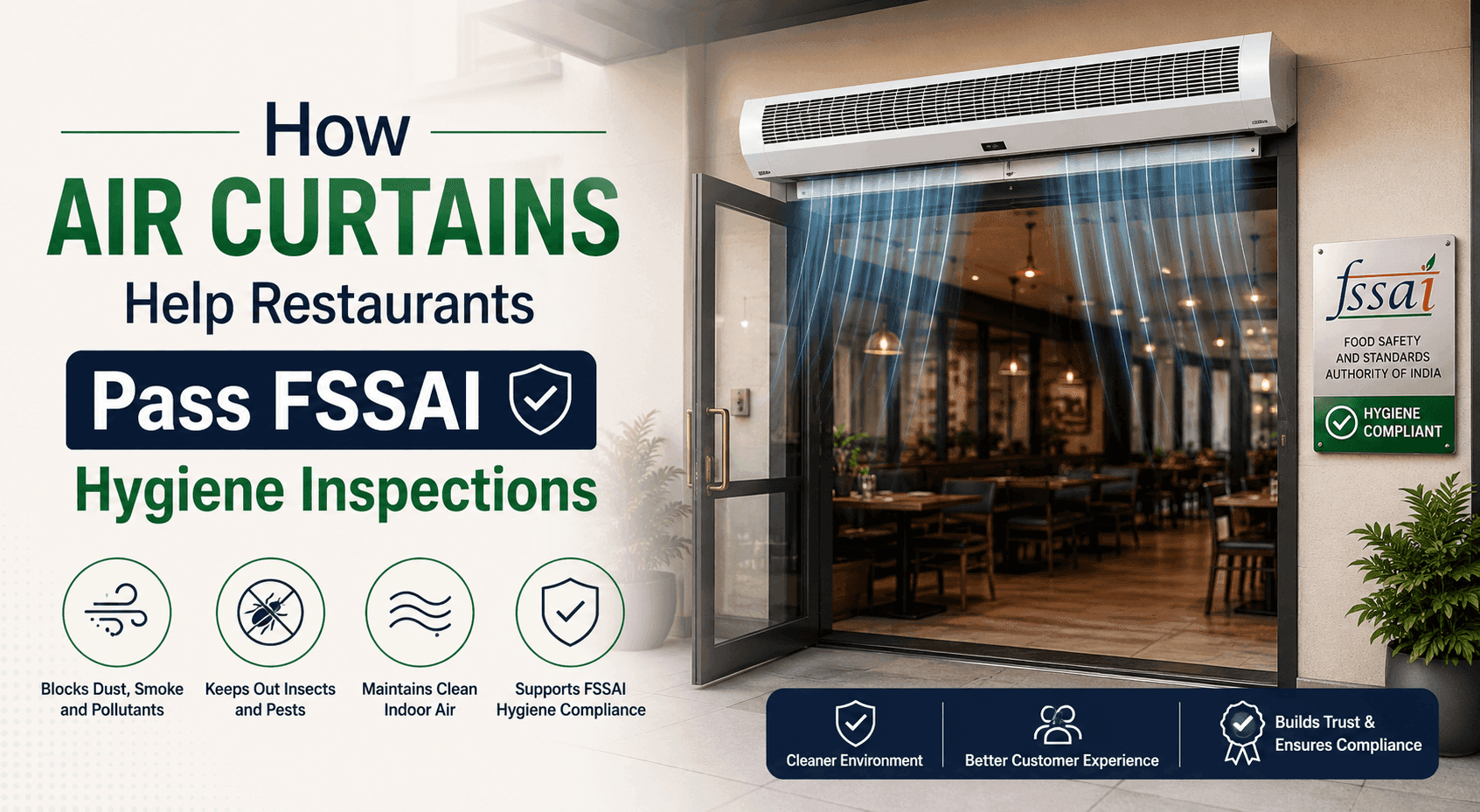
How Air Curtains Ensure FSSAI Hygiene Compliance for Restaurants
Mitzvah Team
Published: May 30, 2026Updated: June 15, 2026
Explore how air curtains act as a frontline defense against contaminants, helping restaurants maintain the hygienic standards needed to satisfy FSSAI inspectors and pass critical hygiene checks.
The FSSAI Inspector Is Coming. Is Your Kitchen Ready?
Picture this: it is a busy Tuesday afternoon. Orders are flowing in from Swiggy and Zomato, your kitchen staff is in full swing and an FSSAI food safety officer walks through your front door for an unannounced inspection.
You know your food tastes great. But is your kitchen inspection-ready?
FSSAI inspections are not about taste. They are about hygiene, pest control, entry point protection, and whether your kitchen infrastructure meets the standards set under Indian food safety law.
Failing an FSSAI inspection can mean:
Monetary fines under the Food Safety and Standards Act, 2006
Suspension or cancellation of your FSSAI license
A drop in your Hygiene Rating visible to every customer on Swiggy and Zomato
Reputational damage that is hard to recover from
Here is what most restaurant owners do not realize: one straightforward installation can help you address multiple FSSAI checklist points in one go.
That installation is an air curtain.
What FSSAI Actually Checks in a Restaurant Kitchen
Before understanding how an air curtain helps, it is important to know what FSSAI inspectors are actually looking for.
FSSAI's Hygiene Rating Scheme rates food businesses on a score of 1 to 5 based on compliance with food safety requirements. The inspection covers everything from raw material storage to staff hygiene to kitchen infrastructure.
The areas most directly relevant to air curtains are:
Pest and insect control — Is there evidence that flies, mosquitoes, and cockroaches are being actively prevented from entering the kitchen?
Entry point protection — Are all doors, windows, and openings adequately protected against external contaminants?
Air quality and cross-contamination — Is the kitchen protected from dust, smoke, and outside pollutants that could contaminate food?
Chemical-free pest control during food preparation — Use of insecticide sprays during cooking hours is strictly prohibited by FSSAI
Critically, Schedule 4 of the FSS (Licensing and Registration of Food Businesses) Regulations, 2011 — the regulatory backbone of FSSAI kitchen compliance — explicitly states:
"The doors should have tight air filters or curtains so that dust particles do not enter the room."
This single line is why an air curtain is not just a convenience. For FSSAI compliance, it is a documented requirement.
What Is an Air Curtain and How Does It Work?
An air curtain is a device installed above a doorway or entry point that projects a continuous, high-velocity stream of air downward across the opening.
This invisible wall of air creates a barrier that:
Stops flies and insects from entering the kitchen
Blocks dust, smoke, and outside contaminants from drifting in
Separates indoor and outdoor temperatures without closing the door
Allows free movement of staff without touching anything
Unlike fly traps, insecticide sprays, or plastic strip curtains, an air curtain works silently and continuously — 24 hours a day, without chemicals, without degradation, and without requiring staff to do anything differently.
In a busy restaurant kitchen where doors are constantly opening and closing, an air curtain is one of the most practical hygiene investments available.
How an Air Curtain Directly Helps You Pass FSSAI Inspection
This is the section that matters most for restaurant owners preparing for an FSSAI audit.
Here is how an air curtain maps directly to FSSAI inspection checklist requirements:
FSSAI Checklist Point | How Air Curtain Helps |
Pest and insect control evidence | Creates a continuous fly barrier at all open doorways — no flies enter |
Entry point protection at doors | Directly fulfils the Schedule 4 requirement for air filters or curtains at doors |
Air quality in food preparation area | Blocks dust, smoke, and outdoor pollutants from entering the kitchen |
No insecticide sprays during food prep | Air curtain is 100% chemical-free — eliminates the need for spray-based fly control |
Physical barriers at all openings | FSSAI guidelines explicitly require curtains or filters at entry points |
Overall hygiene infrastructure | Signals proactive hygiene management to the inspecting officer |
When an FSSAI officer walks into your kitchen and sees an air curtain running above the entry door, it immediately communicates that your establishment takes hygiene infrastructure seriously. That perception matters in how inspections are scored.
Why Strip Curtains Alone Are Not Enough
Many restaurant kitchens in India rely on PVC strip curtains hanging across doorways. They are inexpensive and widely available but they have serious limitations that FSSAI inspectors notice.
Problems with strip curtains:
Staff push them aside constantly, defeating their purpose
Gaps between strips allow small insects through easily
They collect grease, dust, and food particles becoming a contamination source themselves
They are not classified as air filters under FSSAI's Schedule 4 language
They deteriorate quickly in high-traffic kitchen environments
An air curtain, by contrast:
Requires zero manual interaction no touching, no pushing aside
Provides a uniform, unbroken barrier across the entire doorway
Has no surface that collects grease or bacteria
Meets the "air filter or curtain" requirement far more robustly
Lasts years with minimal maintenance
For restaurants in high-footfall cities like Delhi, Mumbai, Bangalore, and Hyderabad — where FSSAI enforcement has become significantly more active relying only on strip curtains is a compliance risk.
Air Curtain for Restaurant Kitchen: Where to Install It
Knowing where to install air curtains is as important as choosing the right one. Here are the key positions in a restaurant setup:
Main Kitchen Entry Door
The most critical point. This is where staff, delivery personnel, and raw materials enter and exit — and where flies are most likely to follow movement in.
Delivery and Loading Entrance
Back-of-house delivery doors are often left open for extended periods. This is a major insect entry point that is frequently flagged during FSSAI inspections.
Passage Between Raw Material Storage and Prep Area
Cross-contamination between raw material zones and food preparation areas is a key FSSAI concern. An air curtain at this internal passage adds a layer of separation.
Cold Room or Freezer Door
Air curtains at cold storage entries serve a dual purpose they reduce temperature loss (cutting electricity costs) while preventing insect entry into refrigerated zones.
Service Window Between Kitchen and Dining Area
The pass-through window between your kitchen and dining area is another common insect pathway. A compact air curtain here keeps the kitchen-to-plate journey hygienic.
Installation note: Air curtains require no major civil work. They mount to the door frame or ceiling above the opening and run on standard electrical connections. Most units are operational within a few hours of installation.
Choosing the Best Air Curtain for FSSAI Compliance
Not all air curtains are equally effective for restaurant kitchen environments. Here is what to evaluate before purchasing:
Air Velocity Look for a minimum air velocity of 8–10 m/s at floor level. Below this threshold, flies can push through the air stream. Higher velocity = stronger insect barrier.
Door Width Coverage The air curtain must match or exceed your door width. Gaps at the sides allow insects in. Always measure door width before selecting a unit.
Noise Level Restaurant kitchens are already loud. Choose a unit with a low decibel rating, especially for units near dining areas or service windows.
Energy Efficiency Air curtains run continuously during kitchen hours. An energy-efficient motor reduces operating costs without compromising performance.
IP Rating In wet kitchen environments — near dishwashing areas or prep sinks — choose a unit with an appropriate IP rating to handle moisture exposure safely.
Brand Warranty and Service Support in India Ensure the brand has service support in your city. A unit that breaks down before an inspection with no local technician available is a serious problem.
[Internal Link: Restaurant Air Curtain Product Page]
The Real Cost of Not Having an Air Curtain
Restaurant owners sometimes hesitate at the upfront cost of an air curtain. It helps to understand what the alternative actually costs.
FSSAI non-compliance penalties under the Food Safety and Standards Act can range from fines to license suspension depending on the severity and repeat nature of violations.
Hygiene Rating impact: FSSAI's Hygiene Rating is publicly visible. A low rating affects your ranking and visibility on food delivery platforms directly impacting order volume and revenue.
Customer complaints: A single customer complaint about a fly or insect in their food posted publicly on Google, Zomato, or social media can cause reputational damage that far exceeds the cost of any air curtain.
Staff productivity: Kitchens plagued by flies require more time spent on manual pest control, cleaning, and complaint management. An air curtain removes this burden entirely.
When you compare the one-time cost of a quality air curtain against these ongoing risks, the return on investment is clear and quick.
Conclusion: One Installation. Multiple Compliance Points. Zero Flies.
Passing an FSSAI hygiene inspection is not about doing one big thing right. It is about having the right systems in place across every checkpoint from raw material storage to staff hygiene to kitchen entry protection.
An air curtain is one of the few investments that simultaneously addresses:
Entry point protection (Schedule 4 requirement)
Pest and fly control without chemicals
Air quality and dust prevention
Overall hygiene infrastructure credibility
It runs without any daily management. It requires no chemicals. It does not degrade with use. And it signals to every FSSAI inspector that walks through your door that your kitchen takes food safety seriously.
For restaurant owners in India preparing for FSSAI inspections or recovering from a failed one an air curtain for restaurant kitchen is not a luxury upgrade. It is a compliance essential.
Ready to protect your kitchen and pass your next FSSAI inspection with confidence?
Explore our range of FSSAI-compliant air curtains designed specifically for restaurant and commercial kitchen environments.
FAQs
FSSAI's Schedule 4 explicitly requires that doors have tight air filters or curtains to prevent dust and contaminants from entering food preparation areas. While the regulation does not exclusively mandate air curtains by brand or type, an air curtain is the most effective and inspection-accepted way to meet this requirement. It directly addresses multiple points on the FSSAI inspection checklist.
No — and it should not be positioned as a replacement. Pest control services address existing infestations inside the premises. An air curtain prevents new insects from entering through doorways. Both work best together. An air curtain significantly reduces the frequency and intensity of pest control requirements, but a documented pest control program should still be maintained for full FSSAI compliance.
For small restaurant kitchens with standard door widths of 3 to 4 feet, a single-motor air curtain with 8–10 m/s air velocity and low noise output is typically sufficient. Look for units with ISI or BEE certification for energy standards. Brands with pan-India service support are preferable for reliability. [Internal Link: Restaurant Air Curtain Product Page
Open kitchen layouts where the kitchen is partially visible to diners benefit significantly from air curtains at service windows and pass-throughs. For fully open kitchens without defined entry points, air curtains can be combined with physical partitioning and regular pest management. An FSSAI consultant can advise on the best configuration for your specific layout.