

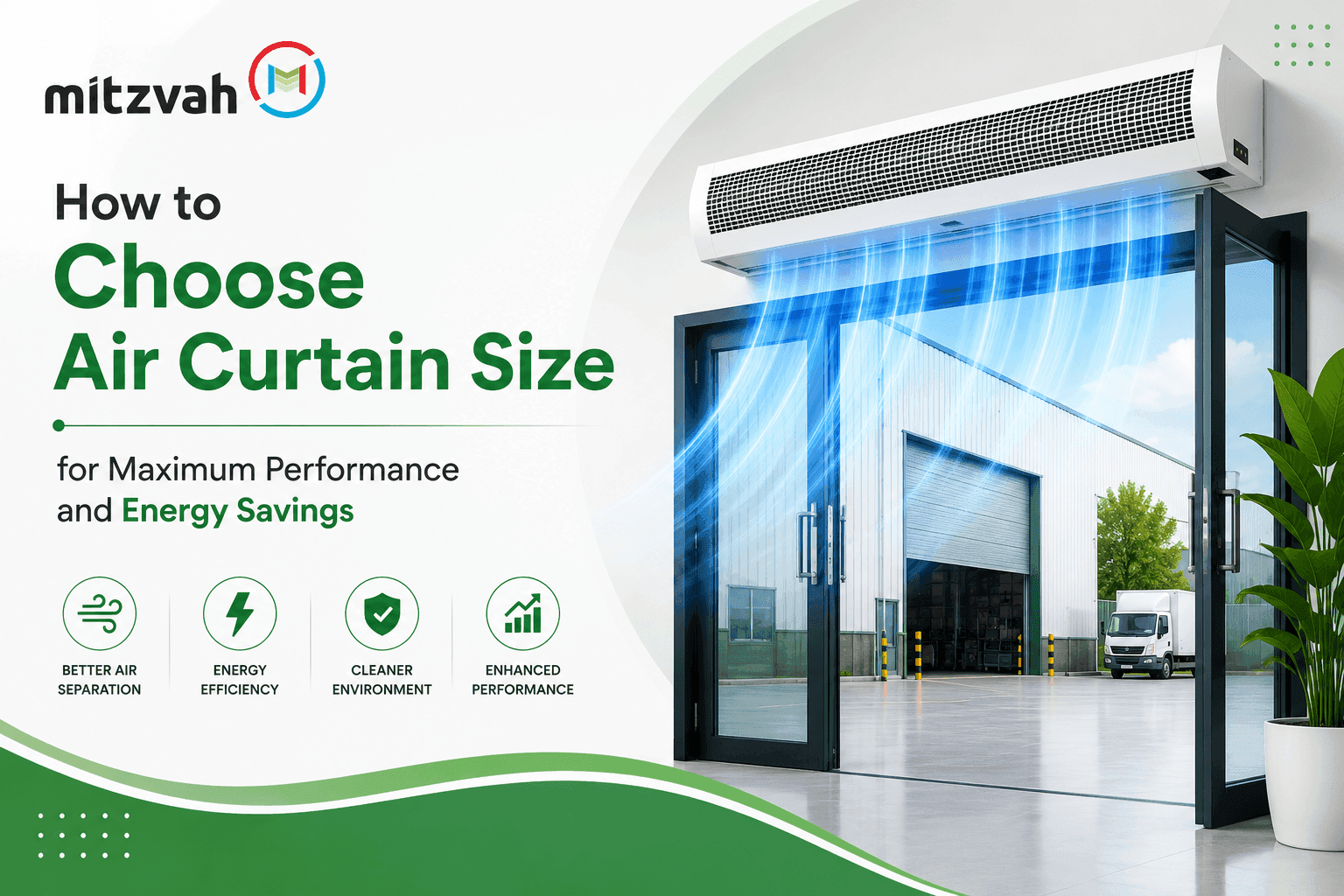
How to Choose Air Curtain Size for Maximum Performance and Energy Savings.
Mitzvah Team
Published: June 24, 2026Updated: June 24, 2026
Learn how to choose the right air curtain size for commercial and industrial doors. Explore door dimensions, airflow requirements, CFM calculations, and expert sizing tips to improve energy efficiency, hygiene, and performance.
Did you know that an open commercial door can waste up to ₹420 worth of conditioned air every single hour? For facility managers, warehouse operators, and retail store owners across India, this silent energy drain adds up to lakhs of rupees annually. The single most effective solution is a correctly sized air curtain and knowing how to choose air curtain size correctly is the difference between a unit that pays for itself in months versus one that underperforms and wastes money. This guide covers everything: door width measurement, door height coverage, CFM calculations, size charts, and a step-by-step selection process.
Key Takeaways
Air curtain width must match or slightly exceed your door's clear opening width never use a shorter unit.
Door height width guide determines CFM requirement: standard commercial doors (up to 10 ft) need 1,000–1,500 CFM; industrial doors (up to 20 ft) need 2,500–3,500 CFM.
A properly sized air curtain blocks 80% of outside air, insects, dust, and fumes while reducing energy loss significantly.
Industrial applications require centrifugal-blower air curtains with air velocity of 15–25 m/s for effective sealing.
Undersized air curtains leave gaps, increase energy bills, and fail to prevent contaminant infiltration.
What Is an Air Curtain?
An air curtain also called an air door or air screen is a device installed above a doorway or opening that projects a controlled stream of high-velocity air downward across the entire width of the opening. This invisible air barrier separates two environments (for example, a conditioned interior from a hot or dusty exterior) without physically closing the door.
Air curtains work by creating a laminar or turbulent airflow curtain that prevents the exchange of indoor and outdoor air, blocks insects, dust, fumes, and airborne contaminants, and maintains the internal temperature of conditioned spaces. They are widely used in retail stores, supermarkets, restaurants, hospitals, cold storage rooms, warehouses, manufacturing plants, and airports.
According to industry data, buildings with properly installed air curtains report energy savings of 40–80% on HVAC costs related to open-door infiltration. Related technologies include PVC strip curtains, insect killers, and HVAC damper systems, but air curtains offer the highest throughput with minimal obstruction to foot traffic or vehicle movement.
80%Energy loss reduction
3L+Mitzvah installations
20 ftMax door height covered
25 m/sMax air velocity (industrial)
Why Proper Air Curtain Sizing Matters
Choosing the wrong size air curtain is one of the most common and costly mistakes facility managers make. An undersized unit leaves exposed gaps at the sides of the door opening, allowing outside air to flow freely completely negating the energy-saving and hygienic benefits. An oversized unit wastes upfront capital and may not deliver the right velocity profile for your specific door height.
Consider a cold storage facility in Delhi: if a 4-foot air curtain is installed over a 5-foot door, a 6-inch gap on each side allows insects, hot humid air, and dust to enter. The refrigeration system works harder, energy bills spike, and food safety is compromised. A correctly sized 5-foot unit, on the other hand, creates a seamless barrier.
From a business standpoint, correct sizing delivers measurable ROI: reduced HVAC load, lower utility bills, improved indoor air quality, enhanced hygiene compliance (critical in food processing and pharma), and greater comfort for customers and employees near entrance doors. Industry research consistently shows that proper air curtain sizing reduces door-related energy loss by up to 80%, with payback periods as short as 6–18 months depending on operating hours and local energy costs.
How to Measure Door Width Correctly
Door width is the primary sizing parameter for any air curtain selection. Here is how to measure it accurately:
Identify the clear opening width: Measure the distance between the inside edges of the door frame (not the outside of the frame). This is the actual opening the air curtain must cover.
Include door panels for double doors: For double-door or bi-fold entrances, measure the total combined clear opening width — not just one panel.
Select a unit width equal to or slightly greater than the opening: Never choose a unit narrower than the door. A unit 100–200mm wider than the opening provides the best coverage and accounts for minor installation offsets.
Check standard sizes available: Air curtains are typically available in 2 ft, 3 ft, 4 ft, 5 ft, and 6 ft widths. For non-standard openings, custom-size units may be required.
Pro Tip: Always measure the door opening — not the door leaf itself. Door leaves are typically 25–50mm narrower than the frame opening. Using the leaf dimension will result in an undersized air curtain.
How to Measure Door Height Correctly
Door height determines the required air velocity and CFM output of your air curtain. The taller the door, the higher the velocity needed to project the air stream to floor level and maintain an effective barrier.
Measure door height as follows:
Measure from finished floor level to the top of the door frame: This is the height the air stream must travel. Include any clearance above the door leaf if the unit will be mounted above the door header.
Account for the installation height of the air curtain unit: The unit is typically mounted 100–200mm above the door frame top. The air jet must still reach floor level from that height.
Match door height to the unit's rated coverage height: Every air curtain has a specified maximum door height it can cover effectively (e.g., "suitable for door heights up to 10 feet"). Always verify this specification against your measurement.
Important: Mounting an air curtain designed for 8-foot doors on a 12-foot opening will result in incomplete coverage at floor level — the air stream loses velocity before reaching the ground and the barrier breaks down.
Understanding Airflow and CFM Requirements
CFM (Cubic Feet per Minute) is the measure of air volume delivered by the air curtain per minute. Higher CFM means more air is moved and a stronger barrier is created. Here is how to determine the CFM your installation requires:
CFM Calculation Method
A simple formula to estimate required CFM:
Required CFM = Door Width (ft) × Door Height (ft) × Air Velocity Factor
Commercial / light-duty factor: 100–120 CFM per sq ft of door area
Industrial / heavy-duty factor: 150–200 CFM per sq ft of door area
Example: A 4 ft wide × 8 ft high retail store entrance = 32 sq ft. At 120 CFM/sq ft, you need approximately 3,840 CFM — select a unit rated at 3,500–4,000 CFM for this opening.
Air Velocity (m/s) Guide
Application | Recommended Velocity | Notes |
|---|---|---|
Small retail / café | 8–13 m/s | Light-duty cross-flow units |
Commercial buildings / offices | 13–18 m/s | Standard commercial models |
Restaurants / supermarkets | 15–20 m/s | Higher velocity for insect control |
Warehouses / factories | 18–23 m/s | Centrifugal-blower industrial models |
Cold storage / blast freezers | 22–25+ m/s | Heavy-duty industrial centrifugal |
Air Curtain Size Chart by Door Dimensions
Use this quick-reference size chart to match your door dimensions to the right air curtain specification. This chart is based on Mitzvah's product range and industry standard sizing guidelines:
Door Width | Door Height (Max) | Recommended Unit Width | Min. CFM Required | Application Type | Mitzvah Series |
|---|---|---|---|---|---|
Up to 2.5 ft (30 in) | Up to 8 ft | 2 ft | 700–1,000 CFM | Commercial | ASP Series (2 ft) |
2.5 ft – 3.5 ft | Up to 10 ft | 3 ft | 1,000–1,500 CFM | Commercial | ARS / ASS Series (3 ft) |
3.5 ft – 4.5 ft | Up to 12 ft | 4 ft | 1,500–2,000 CFM | Commercial | RSL Series (4 ft) |
4.5 ft – 5.5 ft | Up to 14 ft | 5 ft | 2,000–2,500 CFM | Semi-Industrial | RSL / Industrial Series |
5.5 ft – 6.5 ft | Up to 16 ft | 6 ft | 2,500–3,200 CFM | Semi-Industrial | Industrial Series (6 ft) |
6 ft – 10 ft+ | Up to 20 ft | Custom / Tandem | 3,200–5,000+ CFM | Industrial | Heavy-Duty Industrial |
How to Choose Air Curtain Size for Commercial Buildings
Commercial buildings include retail stores, supermarkets, restaurants, hotels, hospitals, and offices. These environments typically have door heights between 7 and 12 feet and moderate foot traffic. Here are the key sizing considerations for each:
Retail Stores and Supermarkets
For a standard single retail door (2.5–3 ft wide, 8–10 ft high), a 3-foot air curtain with 1,100–1,500 CFM output is the correct choice. If your store has a wide entrance (two sliding doors totalling 6–8 ft), use two 3-foot units side by side or a single 6-foot unit. Prioritise units with high-low speed control for energy savings during off-peak hours. Mitzvah's ARS series, with 1,500 CFM at high speed, is well-suited for this application.
Restaurants and Food Service
In restaurant environments, insect control is the primary concern. A unit with a minimum air velocity of 15–18 m/s is recommended. For kitchen service doors or back-of-house entrances that are open for extended periods, a 3-foot or 4-foot air curtain with stainless steel chassis (for hygiene) is ideal. Mitzvah's stainless steel series (ARS-SS) is designed specifically for food-service applications.
Hospitals and Pharmaceutical Facilities
These environments require airlocks and HEPA-grade cleanliness. Air curtain sizing here must account for both door dimensions and the pressure differential between zones. Consult an HVAC professional for precise CFM calculation. Generally, high-velocity units (18–22 m/s) with smooth, cleanable surfaces are specified. Mitzvah has supplied air curtains to multiple hospitals and pharma companies across India.
How to Choose Air Curtain Size for Industrial Facilities
Industrial facilities warehouses, factories, cold storage units, loading docks present unique challenges: large door openings (10–30 ft wide and tall), high-traffic vehicle access, and demanding environments. Here is how to approach air curtain sizing in industrial settings:
Key Factors for Industrial Sizing
Door Type: Industrial doors include roller shutters, sectional overhead doors, and bi-fold high-speed doors. Measure the full clear opening, not just the door leaf, and account for the speed at which the door operates fast-cycling doors may require high-response air curtain controls.
Pressure Differential: Industrial spaces often have positive or negative pressure relative to the outdoors (e.g., clean rooms, paint booths). A higher pressure differential requires greater air velocity (22–25+ m/s) to maintain the barrier. Consult an engineer for these applications.
Temperature Extremes: Cold storage facilities at -18°C to -40°C require heated air curtains with insulated blower sections to prevent ice formation on the unit itself. Mitzvah's heavy-duty industrial series is rated for operation down to -40°C.
Tandem Installation: For openings wider than 6 feet, tandem (side-by-side) installation of two or more units is the standard approach. Each unit covers half the opening, and controls are synced for simultaneous operation.
Air Curtain Type Comparison Table
Feature | Cross-Flow (Standard) | Centrifugal (Industrial) | Heated Air Curtain | Best For |
|---|---|---|---|---|
Air velocity | 8–16 m/s | 15–25+ m/s | 12–20 m/s | — |
Door height coverage | Up to 10 ft | Up to 20 ft+ | Up to 14 ft | — |
Noise level | Low (silent models) | Moderate–high | Low–moderate | — |
Energy efficiency | High | Moderate | Moderate (heater adds load) | — |
Construction | Aluminium / plastic | MS powder-coated / SS | Aluminium / SS | — |
Typical applications | Retail, offices, restaurants | Warehouses, factories, cold storage | Entrances in cold climates | — |
Price range (Mitzvah) | ₹14,000 – ₹53,900 | ₹35,000 – ₹1,20,000+ | ₹45,000 – ₹1,50,000+ | — |
Best for | Light–Medium Commercial | Heavy Industrial | Cold-Climate Entrances | — |
Step-by-Step Air Curtain Selection Process
1Measure your door opening (width and height)
Using a steel tape measure, record the clear opening width (inside frame to inside frame) and the height from finished floor to the top of the door header. Note whether the door is a single, double, or rolling-shutter type, as this affects both width and mounting considerations. Write down both measurements in feet and inches for reference during product selection.
2Identify your application type and environment
Determine whether your application is commercial (retail, restaurant, hospital, office) or industrial (warehouse, cold storage, factory, loading dock). Also note the environment: is it a dusty factory floor, a hygienic kitchen, a cold storage room, or a simple retail entrance? Environment dictates material selection (stainless steel for food-grade, MS powder-coated for industrial) and air velocity requirements.
3Calculate required CFM
Multiply your door's clear opening area (width × height in square feet) by the appropriate CFM factor for your application. Use 100–120 CFM per sq ft for commercial applications and 150–200 CFM per sq ft for industrial settings. This gives you the minimum CFM rating to look for when evaluating air curtain models. Always round up to the next available product tier rather than down.
4Match unit width and rated height to your door
Select a unit whose width equals or slightly exceeds your door's clear opening width. Verify that the unit's rated maximum door height coverage meets or exceeds your door height measurement. Check the manufacturer's specification sheet look for "door height covered" or "effective coverage height." For doors taller than 10 ft, industrial centrifugal models are required; standard cross-flow units will not project air effectively to floor level.
5Confirm mounting requirements and controls
Verify that the mounting location above the door is structurally suitable for the weight of the unit. Confirm the electrical supply requirements (220V single-phase for most commercial units, 440V three-phase for heavy industrial models). Check available control options — remote control, door sensor activation, thermostat control, or BMS integration — and ensure these match your operational requirements before placing the order.
Common Air Curtain Sizing Mistakes to Avoid
Mistake 1: Buying an air curtain shorter than the door width
Consequence: Air gaps on the sides allow insects, dust, and outside air to enter freely, defeating the purpose entirely and wasting the purchase cost.
Always select a unit equal to or slightly wider than the full clear opening width of the door.
Mistake 2: Using a standard commercial unit for a tall industrial door
Consequence: The air stream loses velocity before reaching floor level on a 14–20 ft door, leaving the lower half of the opening unprotected.
For doors above 10 ft, specify an industrial centrifugal air curtain with rated coverage for your actual door height.
Mistake 3: Ignoring CFM requirements
Consequence: A visually correct-sized unit may still underperform if its CFM output is insufficient for the door area — particularly in wide openings or windy environments.
Always calculate required CFM based on door area before selecting a model, and compare against the product's rated CFM specification.
Mistake 4: Mounting the unit too high above the door header
Consequence: Even a correctly sized unit will lose effectiveness if mounted significantly above the door frame, as the air stream must travel a greater distance to reach floor level.
Mount the air curtain as close to the top of the door frame as the bracket design allows — typically 50–150mm above the header.
Mistake 5: Using one unit for a very wide double-door without checking rated width
Consequence: A 3 ft unit cannot cover a 6 ft double-door entrance. Air infiltration occurs across the uncovered half of the opening.
Use a unit that matches the full combined width, or install two units side by side with synchronised controls.
Mistake 6: Selecting the wrong voltage or phase for the installation site
Consequence: A 440V three-phase industrial unit cannot be connected to a standard single-phase 220V commercial supply the motor will not operate or will be damaged.
Confirm the electrical supply specifications at the installation site before ordering and match them to the product's rated voltage.
Mistake 7: Choosing stainless steel for cost savings in non-food environments — or vice versa
Consequence: Standard aluminium or MS units are unsuitable for direct food-contact areas (rust risk). Stainless steel units in dry industrial settings are unnecessarily expensive.
Choose SS 304 chassis for food, pharma, and wet environments; MS powder-coated for dry industrial; aluminium plastic for standard commercial.
Industry Applications and Use Cases
Retail Stores
3 ft air curtains at entrance doors reduce AC loss, prevent insect entry, and improve customer comfort. Mitzvah customers like Haldirams and V Mart use air curtains at all entry points.
Commercial Buildings
Office lobbies with automatic sliding doors benefit from 4–6 ft units that maintain consistent lobby temperatures and reduce dust infiltration without impeding access.
Manufacturing Plants
Factory loading bays and production floor entrances require industrial centrifugal units (15–25 m/s) to maintain zone separation and prevent cross-contamination between areas.
Warehouses
Dock doors (10–14 ft high, 8–12 ft wide) need heavy-duty air curtains in tandem configuration. They reduce energy loss during loading/unloading and prevent pest entry.
Hospitals
High-velocity air curtains at hospital entrances and between sterile zones reduce airborne pathogen transfer. Mitzvah has equipped multiple hospitals with air curtain systems that improved hygiene audit scores.
Restaurants & Hotels
Restaurants require units with stainless steel or food-grade ABS construction, a minimum 15 m/s velocity for insect control, and quiet operation to maintain ambiance for diners.
Expert Insights
"In over 22 years of air curtain manufacturing and installation across India, the most common mistake we see is selecting unit size by price rather than door specifications. A ₹5,000 saving on an undersized unit often results in ₹40,000+ in excess energy costs over a single year. Always size first, budget second."
— Mitzvah Engineering Team, Mitzvah Engg (India) Limited, Noida
According to industry research published by the Air Movement and Control Association (AMCA) in 2023, correctly specified and installed air curtains can prevent up to 95% of airborne insect penetration through open doorways, and reduce HVAC energy consumption attributable to open doors by 60–80% depending on climate zone and operating hours.
Conclusion
Knowing how to choose air curtain size correctly is the most important step in any air curtain installation. The process is straightforward when approached systematically: measure your door's clear opening width and height, calculate the required CFM for your application type, and match those specifications to a unit with verified coverage ratings. Never compromise on unit width a unit that is even slightly narrower than the door opening will underperform significantly.
For commercial applications retail stores, restaurants, hospitals, and offices standard cross-flow air curtains in 2 ft to 6 ft widths cover the vast majority of needs, with commercial-grade models handling doors up to 10 feet. For industrial settings with tall, wide, or high-traffic openings, centrifugal-blower units are the correct specification, particularly for door heights above 10 feet where higher air velocity and throw distance are critical.
The right air curtain is an investment that pays back rapidly through energy savings, improved hygiene, reduced pest problems, and greater comfort for your customers and employees. A correctly specified Mitzvah air curtain, installed to manufacturer guidelines, can operate 24×7 with minimal maintenance and deliver consistent results for years.
If you are unsure about the right size or series for your application, Mitzvah's technical team offers free site consultations and custom sizing recommendations across India. With over 22 years of experience and more than 3 lakh installations from small café entrances to airport terminals Mitzvah has the expertise to help you choose exactly the right solution for your facility.
Get a Free Air Curtain Sizing Consultation
Not sure which Mitzvah model is right for your door? Our technical team will assess your requirements and recommend the ideal air curtain size completely free of charge.
Related Resources from Mitzvah
Explore more guides and product pages to help you make the right air curtain decision.
What Is an Air Curtain?Advantages of Air CurtainsAir Curtain Installation GuideShop All Air CurtainsASP Series (Best Seller)Contact Mitzvah
FAQs
To choose the correct air curtain size, measure your door's exact clear opening width and height. Select a unit whose width matches or slightly exceeds the opening width, and whose rated coverage height meets your door height. Then calculate the required CFM (door area × 100–150 CFM per sq ft for commercial; 150–200 for industrial) and confirm the selected model meets that output. For doors above 10 ft, specify an industrial centrifugal model.
Yes. An air curtain should match the door's clear opening width exactly or be slightly wider never narrower. A unit shorter than the opening leaves exposed gaps on the sides that allow outside air, insects, and dust to bypass the air barrier. For double-door entrances, use a single unit spanning the full combined width, or two units installed side by side with synchronised controls.
CFM requirements depend on door dimensions and application type. For commercial doors up to 10 ft high, plan for 1,000–1,500 CFM. For industrial or semi-industrial doors of 12–16 ft, 2,000–2,500 CFM is recommended. Tall warehouse or loading dock doors at 18–20 ft typically need 3,000+ CFM. As a formula: Required CFM = Door Width (ft) × Door Height (ft) × 100–200 (depending on application intensity).
Yes but only if the single unit's length matches the total combined clear opening width of both doors. For example, two 3 ft door panels = 6 ft total opening; you need a single 6 ft unit or two 3 ft units. Using a single 3 ft unit for a 6 ft opening covers only half the entrance and offers minimal effectiveness for the overall opening.
An undersized air curtain leaves air gaps at the sides of the door opening, allowing outside air, insects, dust, and contaminants to infiltrate. In air-conditioned commercial spaces, this means higher energy bills as the HVAC system works harder to compensate. In cold storage, it causes temperature fluctuations that affect product integrity. In food production environments, it fails hygiene compliance standards.
Centrifugal-blower air curtains are best for industrial applications due to their higher static pressure, greater air throw distance, and robust construction. They achieve air velocities of 18–25 m/s, which is necessary to maintain effective barriers across large openings (12–20 ft high) and in environments with pressure differentials or strong air drafts. Mitzvah's industrial series is built with MS powder-coated or stainless steel chassis for durability in demanding environments.
The maximum effective installation height depends on the model. Standard commercial cross-flow air curtains are rated for door heights up to 10 feet. Industrial centrifugal models can effectively cover door heights of 12–20 feet. For openings taller than 20 feet (such as high-bay factory doors), vertical side-mounted units, tandem overhead units, or custom configurations designed for the specific opening are required.
Yes, significantly. A correctly sized and installed air curtain can reduce energy loss through open commercial doors by 60–80%. By blocking the constant exchange of conditioned indoor air with hot or humid outdoor air, the air curtain dramatically reduces the load on your air conditioning or heating system. Mitzvah customers across India regularly report reductions in AC bills of 40–60% after installation, with payback periods as short as 6–12 months.