

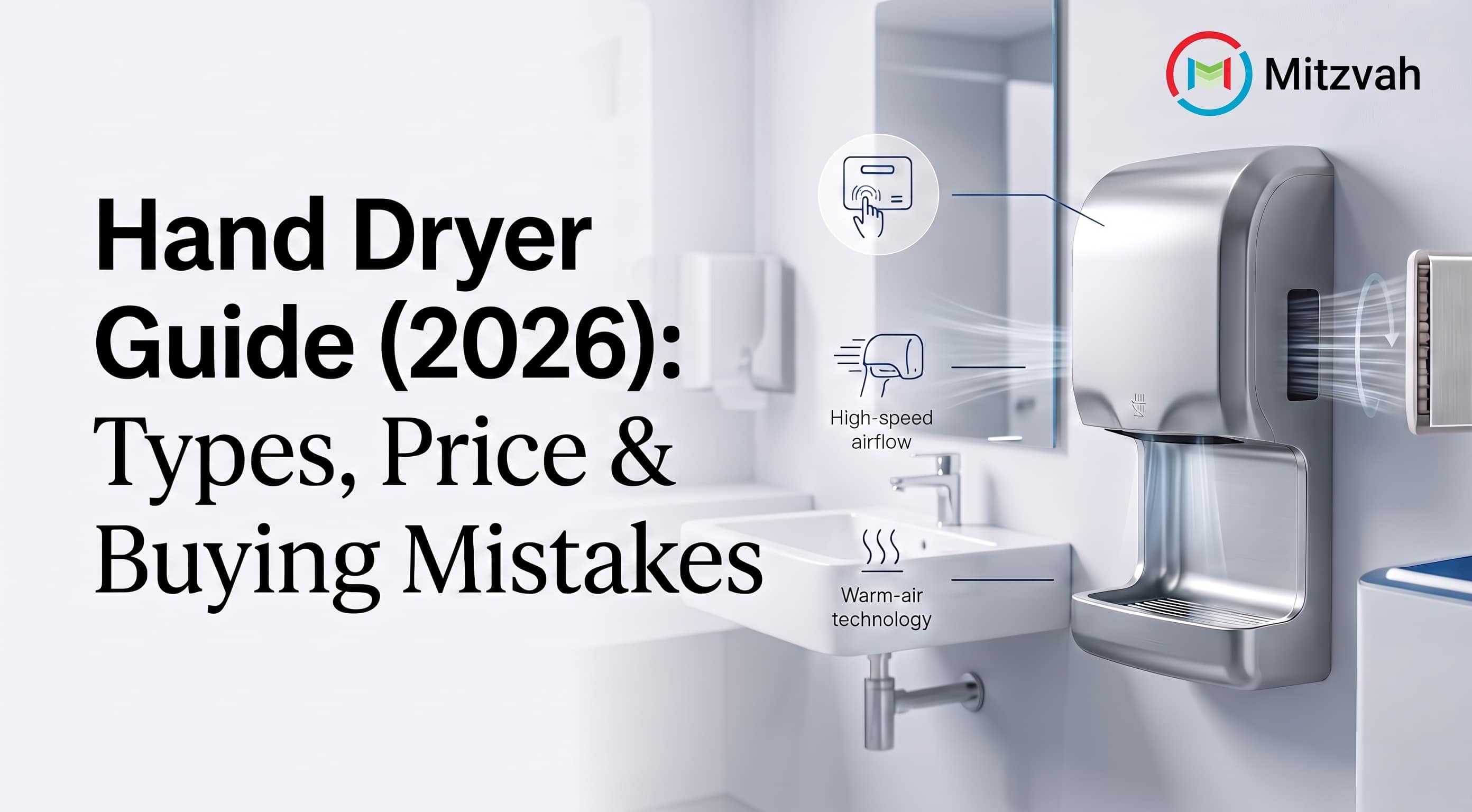
Hand Dryer: Types, Benefits, Price, Size & How to Choose the Right One
Mitzvah Team
Published: August 18, 2026Updated: August 18, 2026
A hand dryer dries hands using directed airflow instead of paper towels. Main types: automatic (touchless), jet air (fast), and hot air (traditional). Choice depends on washroom traffic, noise, space, and installation height, which varies by model.
A hand dryer is an electrically powered washroom fixture that dries wet hands using a stream of air, activated either by a sensor or a push button. Commercial facilities install them to speed up hand drying, cut paper towel costs, and reduce washroom waste. The three broad categories are automatic (sensor) dryers, jet air dryers, and hot air dryers, each suited to different traffic levels and budgets. This guide walks through how hand dryer work, how they compare, what they cost to run, and how to pick the right one for an office, hotel, hospital, restaurant, or industrial washroom.
What Is a Hand Dryer?
A hand dryer is a wall-mounted or countertop electrical appliance that removes moisture from hands using directed airflow instead of paper towels or cloth. Commercial units are typically housed in a stainless steel or ABS plastic casing and are designed for continuous, high-frequency use in public and semi-public washrooms.
Facilities choose hand dryers over paper towels for a mix of reasons: lower ongoing consumable costs, less washroom litter, and a touchless, low-maintenance experience for staff and visitors. They are common in offices, hotels, hospitals, restaurants, malls, airports, schools, and factories, where washroom traffic is frequent and consistent.
How Does a Hand Dryer Work?
Most commercial hand dryers follow the same basic sequence:
1. Sensor activation – An infrared sensor detects hands placed near or under the unit and triggers the motor.
2. Air intake – A fan draws in ambient air through an intake grille, often passing it through a basic filter.
3. Airflow generation – A motor forces the air through a narrow nozzle or outlet, increasing its velocity.
4. Hand drying – The high-velocity air strips moisture from the skin, either by evaporation (hot air models) or by physically pushing water off the hands (jet air models).
5. Automatic shut-off – The unit stops airflow once hands are removed or after a preset time, to limit power draw.
The core mechanics are consistent across brands; what changes is motor power, air velocity, and whether heat is used, which is what separates the main types below.
Types of Hand Dryers
Automatic Hand Dryer
Automatic hand dryers use an infrared or motion sensor so users never touch the unit. This touchless operation is a major reason facilities in healthcare, hospitality, and food service prefer them, since it limits surface contact in high-traffic washrooms.
• Advantages: touchless use, consistent activation, suited to washrooms with continuous footfall, generally straightforward to maintain.
• Limitations: sensor sensitivity can vary with ambient light or dust build-up, and units may need periodic sensor cleaning to keep working reliably.
Jet Hand Dryer
Jet (or “jet air”) hand dryers push a thin, high-velocity sheet of unheated or lightly warmed air across the hands, physically scraping water off the skin rather than evaporating it. This generally makes them faster than traditional hot air models.
• Advantages: faster drying in high-traffic settings, often lower running heat, works well in busy commercial washrooms.
• Limitations: can be louder due to the high air velocity, and some models cost more upfront than basic hot air units.
Hot Air Hand Dryer
Hot air hand dryers rely on heated airflow to evaporate moisture from the hands over a longer cycle than jet air models. They are the traditional, widely recognised category of commercial hand dryer.
• Advantages: simple mechanism, broadly familiar to users, available across a wide range of price points.
• Limitations: typically slower drying time compared with jet air models, and heating elements add to power draw during operation.
Electric Hand Dryer
“Electric hand dryer” is often used as a general term covering any mains-powered hand dryer, automatic or manual. What distinguishes models within this category is usually the drive technology: standard AC motors versus brushless DC motors, the latter generally offering longer motor life and more consistent airflow, though actual performance depends on the specific model and manufacturer specification.
Hand Dryer vs Jet Hand Dryer vs Hot Air Dryer
Feature | Standard / Hot Air | Jet Air | Automatic Sensor |
Drying speed | Generally slower, relies on evaporation | Generally faster, air physically removes water | Depends on underlying motor type (hot air or jet) |
Operation | Push-button or sensor | Usually sensor-activated | Sensor-activated, touchless |
Hygiene | Touchless if sensor-based; touch models require contact | Touchless in most commercial models | Touchless by design |
Noise | Moderate | Can be higher due to high air velocity | Varies by underlying motor and airflow design |
Energy use | Heating element adds to power draw | Often lower heat use, but motor power can be high | Depends on underlying hot air or jet mechanism |
Maintenance | Filter and heating element checks | Filter and nozzle checks | Sensor cleaning plus mechanical maintenance |
Best suited for | Lower-traffic or budget-conscious washrooms | High-traffic commercial washrooms | Washrooms prioritising touchless, hygienic operation |
Note: exact drying times, noise levels, and power ratings vary by model and manufacturer. Always check verified product specifications before comparing units directly.
Benefits of Using a Hand Dryer
• Touchless operation reduces the need to handle a dispenser or bin lid.
• Reduces ongoing paper towel purchases and the waste they generate.
• Provides continuous availability without restocking, unlike towel dispensers.
• Can support lower long-term operating costs compared with regularly replenished paper towels, depending on usage volume and local costs.
• Fits well into commercial washroom design with wall-mounted, low-maintenance units.
• Generally durable when properly maintained, with long service life expected from commercial-grade units.
• Contributes to a cleaner-looking washroom with less litter around bins.
It's worth being cautious here: hand dryers are not universally proven to be more hygienic than paper towels. Outcomes depend on the specific device, how well it's maintained, and how users dry their hands, a point covered in more detail later in this guide.
How to Choose the Right Hand Dryer
Selecting a hand dryer for a commercial or institutional washroom comes down to matching the unit to your traffic, space, and budget. Key factors to evaluate:
1. Washroom traffic – Higher footfall washrooms (malls, airports, factories) generally benefit from faster jet air units.
2. Drying speed – Match expected drying time to how quickly users need to move through the washroom.
3. Sensor technology – Confirm the sensor type is reliable for your washroom's lighting and layout.
4. Airflow and air velocity – Higher velocity units generally dry hands faster, but check manufacturer figures rather than assuming.
5. Power consumption – Review the wattage rating, especially if you're installing multiple units.
6. Noise level – Important in hospitals, hotels, and offices where a quiet washroom experience matters.
7. Size and available wall space – Confirm the unit's dimensions fit your washroom layout.
8. Installation requirements – Check electrical supply, mounting hardware, and wall type compatibility.
9. Material and durability – Stainless steel casings tend to hold up well in high-traffic or industrial settings.
10. Maintenance needs – Consider how easy the unit is to clean and service.
11. Budget – Balance upfront unit cost against expected running costs over time.
12. Intended environment – A hospital washroom has different priorities (noise, hygiene) than a factory washroom (durability, speed).
Quick buyer checklist: confirm washroom traffic level → shortlist automatic vs jet vs hot air → check available wall space and mounting height → review wattage and noise specifications → confirm installation and electrical requirements → compare verified pricing and warranty terms.
Hand Dryer Size and Installation Height
Hand dryer dimensions vary by model, so it's important to check the manufacturer's specification sheet rather than assume a standard size. Before purchase, confirm:
• The unit's width, height, and depth against your available wall space.
• Clearance needed around the unit for hand movement.
• Mounting hardware and wall type (tile, drywall, concrete) compatibility.
• Proximity to washbasins, so users can move naturally from washing to drying.
• Electrical supply location and whether new wiring or an existing socket is needed.
There is no single universal installation height that applies to every hand dryer. The correct mounting height depends on the specific model, applicable accessibility standards, the facility type, and the expected user group (for example, washrooms serving children or wheelchair users may need adjusted heights). Always refer to the manufacturer's installation guidance and relevant local accessibility standards when planning installation.
How Much Does a Hand Dryer Cost?
Hand dryer pricing is influenced by several factors rather than a single specification:
• Type – jet air units are often priced differently from basic hot air models.
• Motor – brushless DC motors typically cost more than standard AC motors.
• Drying speed – faster units often carry a price premium.
• Sensor technology – more advanced sensors can add to unit cost.
• Material – stainless steel casings generally cost more than plastic ones.
• Noise level – engineering for quieter operation can affect price.
• Filtration – built-in air filtration adds cost but can improve hygiene and reduce dust output.
• Durability and build quality – commercial-grade units built for continuous use are priced differently from light-duty models.
• Commercial vs heavy-duty use – units rated for industrial or very high-traffic use are typically positioned at a higher price point.
• Brand and warranty – warranty length and brand reputation both factor into pricing.
We haven't included specific price figures here, since accurate pricing depends on the exact model and current market rates. For verified pricing on Mitzvah's hand dryer range, check current listings directly on the Mitzvah hand dryer range.
How Much Electricity Does a Hand Dryer Use?
Electricity use depends on the unit's power rating, how long it runs per use, and how often it's used. The basic calculation is:
Power consumption × operating time × electricity tariff = estimated electricity cost
Worked example (hypothetical figures only): Suppose a hand dryer is rated at 1.2 kW and runs for an average of 20 seconds per use (about 0.0056 hours). If a washroom sees 200 uses per day:
• Energy per use: 1.2 kW × 0.0056 hours ≈ 0.0067 kWh
• Daily energy use: 0.0067 kWh × 200 uses ≈ 1.34 kWh
• At a hypothetical tariff of ₹8 per kWh, daily cost ≈ ₹10.7
These numbers are illustrative only. Actual electricity consumption varies significantly based on the specific model's power rating, average drying time, washroom footfall, and local electricity tariffs. Always calculate costs using the verified specification of the exact model you're evaluating.
Where Are Commercial Hand Dryers Used?
• Offices – moderate traffic, noise level and appearance often matter most.
• Hotels – guest experience and quiet operation are typically priorities.
• Restaurants – fast turnaround and hygiene are key in food service washrooms.
• Hospitals – hygiene, low noise, and reliability are especially important.
• Shopping malls – high traffic calls for durable, fast-drying units.
• Airports – continuous, heavy use demands robust, commercial-grade equipment.
• Schools and colleges – durability and ease of maintenance matter, along with accessible mounting heights.
• Factories – industrial environments often need rugged, easy-to-clean units.
• Public facilities – vandal-resistant, low-maintenance designs are often preferred.
The right feature set changes by environment: a hospital washroom prioritises hygiene and quiet operation, while a factory washroom prioritises durability and fast drying.
Hand Dryer Maintenance Tips
• Clean the sensor regularly to maintain reliable, touchless activation.
• Clear dust and debris from the air intake to protect the motor.
• Check and clean or replace filters where the model includes one.
• Wipe down the exterior surface regularly, especially in high-traffic washrooms.
• Listen for unusual noise, which can indicate a maintenance issue.
• Periodically check that airflow strength hasn't dropped, which can signal blockages.
• Schedule professional servicing for commercial units on a regular basis.
• Always follow the manufacturer's specific maintenance instructions for your model.
Is a Hand Dryer Better Than Paper Towels?
There's no single right answer here, it depends on priorities:
• Initial investment: Hand dryers require higher upfront cost than a towel dispenser, but eliminate ongoing towel purchases.
• Operating costs: Hand dryers use electricity instead of consumable paper, which can lower ongoing costs over time depending on usage volume.
• Waste: Hand dryers generate no paper waste, while paper towels contribute to washroom litter and disposal needs.
• Maintenance: Hand dryers need occasional servicing; paper towel dispensers need regular restocking.
• Drying speed: This varies by hand dryer type and paper towel format, rather than favouring one category outright.
• Hygiene considerations: Research on hygiene outcomes between hand dryers and paper towels shows mixed results, and outcomes can depend on the specific device, maintenance quality, washroom ventilation, and individual hand-drying behaviour.
• User experience: Preferences vary; some users find hand dryers more convenient, others prefer the tactile familiarity of paper towels.
• Environmental considerations: Each option has a different environmental footprint, paper consumption versus electricity use, and the better choice can depend on local energy sources and paper sourcing.
For most commercial and institutional washrooms with consistent traffic, hand dryers offer a practical, lower-maintenance long-term solution, but the decision should weigh your specific facility's traffic, budget, and priorities.
Final Thoughts
Choosing the right hand dryer comes down to matching washroom traffic, available space, and budget to the right type, automatic, jet air, or hot air, while checking verified specifications rather than assumptions. If you're evaluating hand dryers for a commercial or public washroom, it's worth comparing drying speed, noise level, and installation requirements side by side before deciding.
If you're planning a washroom upgrade or a new facility fit-out, explore Mitzvah's range of commercial hand dryers to compare options suited to your traffic and space requirements.
FAQs
A hand dryer is an electrically powered washroom device that dries wet hands using a stream of air. Automatic models use sensors to activate airflow without requiring the user to touch the device. Commercial units are built for frequent, continuous use in offices, hotels, hospitals, and other public washrooms.
An automatic hand dryer uses an infrared sensor to detect hands and trigger the motor, which draws in air and forces it out through a nozzle at speed. The airflow strips moisture from the hands, and the unit shuts off automatically once hands are removed.
It depends on traffic and priorities. Jet air dryers generally suit high-traffic washrooms needing fast turnaround, while hot air dryers can work well for lower-traffic or budget-conscious settings. Automatic sensor models are generally preferred wherever touchless operation is a priority.
Electricity use depends on the unit's power rating, average drying time per use, and washroom footfall. It can be estimated using power consumption × operating time × electricity tariff, but actual figures vary by model and should be checked against the manufacturer's specification.
There is no single standard size across all hand dryers; dimensions vary by model and manufacturer. Always check the specific product's dimensions against your available wall space before purchase.
Jet air dryers use high-velocity, often unheated or lightly warmed air to physically push water off the hands, generally drying hands faster. Hot air dryers rely on heated air to evaporate moisture over a longer cycle, and are typically slower but often more familiar to users.
There's no universal installation height that applies to every model or facility. The right height depends on the specific unit, applicable accessibility standards, and the expected user group. Always follow the manufacturer's installation guidance and relevant local accessibility standards.
Pricing depends on factors like motor type, drying speed, material, sensor technology, filtration, and brand. Rather than a fixed range, it's best to compare verified pricing for the specific models you're evaluating, such as those listed in Mitzvah's hand dryer range.