

Air Curtain Benefits in 2024 – Mitzvah Air Curtain Prices
Mitzvah
Published: May 19, 2023Updated: August 27, 2026
Air curtains, also known as air doors, are devices widely used in commercial and industrial settings to create an invisible barrier of air that separates two different environments while allowing the easy flow of people and goods. They offer numerous benefits, ranging from energy savings and insect control to improved indoor comfort and noise reduction. … Continue reading Air Curtain Benefits in 2024 – Mitzvah Air Curtain Prices
Air curtains cost ₹9,000–₹2,00,000 in India in 2024 and typically cut energy loss at an open entrance by 40–80%, paying for themselves within 12–18 months. An air curtain, also known as an air door, is a device that blows a high-velocity stream of air across a doorway to create an invisible barrier between two environments while still allowing people and goods to pass through freely. Beyond energy savings, air curtains also control insects and dust, improve indoor comfort, and reduce noise at busy entrances. This guide covers how they work, what actually drives their price in 2024, and how to pick the right one for your business.
Key Takeaways
• Energy savings: A correctly sized air curtain can cut conditioned-air loss at an open entrance by roughly 40–80%, depending on door size and footfall, lowering HVAC and refrigeration load.
• 2024 price range: Standard commercial air curtains run roughly ₹9,000–₹50,000; heavy-duty industrial units run ₹50,000–₹2,00,000, depending on width, motor power, and controls.
• ROI: Most retail and food-service businesses recover the purchase cost within 12–18 months through reduced energy bills.
• Beyond temperature: Air curtains also block insects, dust, fumes, and outside noise, which matters as much as thermal savings in food, healthcare, and pharma settings.
• AMC matters: Ongoing performance depends on the blower motor and impeller staying maintained; budget for an annual maintenance contract, not just the upfront price.
1. Introduction to Air Curtains
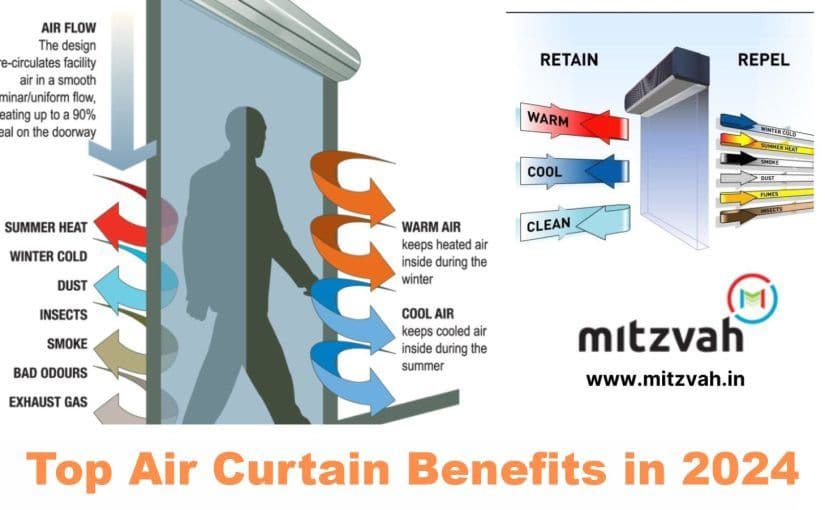
Air curtains have become a standard fixture in Indian retail, hospitality, and industrial buildings for maintaining indoor climate control while cutting energy costs. An air curtain blows a high-velocity stream of air across a doorway opening, creating a seal against outside heat, cold, dust, and insects while leaving the entrance fully open for people and material handling. This continuous air stream acts as an invisible thermal and hygienic barrier, preventing conditioned indoor air from escaping every time the door opens.
2. How Air Curtains Work
Air curtains work on the principle of entrainment — a powerful centrifugal blower pushes air through a narrow nozzle at high velocity, producing a laminar (non-turbulent) air stream across the full width of the doorway. This stream forms a shield between indoor and outdoor environments, resisting the infiltration of outside air, dust, pollutants, and insects while people and trolleys pass through unobstructed. The tighter and more even the airflow, the better the seal — which is why nozzle design, blower RPM, and installation height all affect real-world performance.
3. Energy-Saving Benefits of Air Curtains
The biggest reason Indian businesses buy air curtains is energy savings. By minimising heat or cool air loss at frequently opened entrances, air curtains reduce the load on HVAC and refrigeration systems, cutting electricity consumption and utility bills. In busy retail or QSR outlets where the main door opens hundreds of times a day, an air curtain can meaningfully reduce the compressor and AC run-time needed to hold the setpoint temperature, which is where most of the payback comes from.
4. Maintaining Indoor Comfort with Air Curtains
Air curtains eliminate the cold or hot drafts that customers and staff feel near an open entrance. By sealing the doorway with airflow instead of a physical barrier, they prevent temperature imbalance between the entrance zone and the rest of the store or facility. This reduces how often HVAC systems need to cycle to compensate, and it keeps the experience consistent for anyone standing near the door — a common complaint in stores that don’t have one.
5. Controlling Insects and Airborne Contaminants
Insect and contamination control is one of the most valued air curtain benefits in food service, healthcare, pharma, and manufacturing. The high-velocity air stream forms a physical barrier that stops flies, mosquitoes, dust, and airborne fumes from entering the premises through an open doorway — without needing chemical insecticides near food or patient areas. This is often the deciding factor for FSSAI-conscious kitchens, hospitals, and cold-chain facilities, where hygiene compliance matters as much as temperature control.
6. Enhancing HVAC System Performance with Air Curtains
Air curtains work alongside your HVAC system rather than replacing it. By blocking outside air infiltration at the entrance, they help the HVAC system maintain the target temperature and humidity with less effort, which reduces compressor cycling and can extend equipment life. Facilities with high footfall entrances often see noticeably steadier indoor conditions once an air curtain is installed above the main door.
7. Noise Reduction with Air Curtains
Air curtains also act as a partial acoustic barrier: the air stream disrupts sound transmission through an open doorway, reducing how much outside traffic, machinery, or street noise carries indoors. For businesses near busy roads, airports, or industrial zones, this is a secondary but real benefit alongside the thermal and hygiene advantages. Manufacturers rate blower noise in dB — worth checking if the entrance is near a reception desk or patient area, since a noisier unit can offset the comfort gains.
8. Design and Installation Considerations
Choosing the right air curtain depends on:
• Door width and height – determines the length of the unit and the air velocity needed to cover it fully.
• Air velocity – measured at a standard height from the floor; too low and the barrier fails, too high and it becomes noisy and wasteful.
• Mounting type – horizontal (most common, single unit) versus vertical (used where horizontal mounting isn’t possible, usually needs two units).
• Building pressure differentials – air curtains perform best when the building isn’t fighting strong opposing pressure at the entrance.
• Application requirements – food-grade finishes for kitchens, heated air curtains for cold climates, higher IP ratings for outdoor or industrial exposure.
Professional installation and correct sizing are what separate an air curtain that actually seals the doorway from one that just makes noise. This is also where air curtain price varies the most — a unit installed to spec on a 7-foot commercial entrance costs meaningfully less than an oversized or mis-specified one bought for a wider industrial dock door.
9. Applications of Air Curtains
Air curtains are used across retail stores, supermarkets, restaurants and QSRs, hospitals and diagnostic centres, warehouses, cold storage units, manufacturing facilities, and airports. Anywhere an entrance needs to stay open for continuous foot or material traffic while keeping the indoor environment controlled, an air curtain is a practical fit — which is why it’s one of the most widely deployed HVAC accessories in Indian commercial construction today.
10. Cost-Effectiveness and ROI of Air Curtains
Air curtain price in India for 2024 typically breaks down like this:
Category | Typical Price Range (INR) | Best suited for |
Entry-level commercial | ₹9,000 – ₹25,000 | Small retail shops, boutiques, clinics |
Mid-range commercial | ₹25,000 – ₹50,000 | Restaurants, supermarkets, showrooms |
Heavy-duty industrial | ₹50,000 – ₹1,00,000 | Warehouses, factories, cold storage |
High-capacity / heated | ₹1,00,000 – ₹2,00,000+ | Large dock doors, extreme climates |
Actual air curtain prices depend on door size, motor power, mounting type, and add-ons like heating elements or smart controls. Most businesses recoup the cost within 12–18 months through reduced energy consumption, making it one of the faster-payback investments in facility management. Don’t evaluate on sticker price alone — factor in an annual maintenance contract (AMC), since blower motors and impellers need periodic servicing to keep performance and savings consistent over the unit’s life.
11. Environmental Benefits of Air Curtains
By cutting energy consumption, air curtains indirectly reduce the greenhouse gas emissions tied to electricity use for heating and cooling. For businesses tracking ESG or sustainability targets, an air curtain is a low-cost, high-impact addition — it directly reduces the energy footprint of a building’s most “leaky” point: the entrance.
12. Choosing the Right Air Curtain for Your Needs
Match the air curtain to your doorway, not the other way around. Key factors: door width and height, required air velocity, ambient environmental conditions (dusty, humid, outdoor-facing), and any industry-specific compliance needs (FSSAI for food, GMP for pharma). Consulting with an experienced air curtain manufacturer before purchase avoids the most common and costly mistake: buying an undersized unit for a wide entrance.
13. Case Studies and Success Stories
Retailers, hospitals, cold-storage operators, and QSR chains across India have reported measurable drops in HVAC and refrigeration run-time after installing correctly sized air curtains at their main entrances. The pattern across these deployments is consistent: the higher the footfall through a doorway, the faster the payback, which is why high-traffic retail and food-service entrances see the quickest returns.
14. Common Misconceptions About Air Curtains
A few myths persist around air curtain price and performance:
• “The most expensive unit is always the best.” Performance depends on correct sizing for your specific door, not price alone — see our detailed breakdown of air curtain price misconceptions.
• “Air curtains replace doors.” They complement doors and open entrances; they don’t replace a sealed door where full closure is needed.
• “All air curtains work the same.” Blower power, nozzle design, and air velocity vary significantly between models and directly affect real-world sealing performance.
• “They only work in cold climates.” Air curtains are equally effective at keeping cool, conditioned air inside during Indian summers.
Air Curtain vs. PVC Strip Curtain vs. Chemical Insect Control
A quick side-by-side for buyers deciding between entrance-barrier options:
Factor | Air Curtain | PVC Strip Curtain | Chemical Insect Control |
Keeps entrance fully open | Yes | Yes (push-through strips) | Yes |
Energy/temperature barrier | Strong (40–80% loss reduction) | Moderate | None |
Insect/dust barrier | Strong | Moderate | Strong (but chemical residue) |
Noise reduction | Yes (partial) | Yes (partial) | No |
Typical cost (India, 2024) | ₹9,000–₹2,00,000+ | ₹2,000–₹15,000 | Recurring, ₹500–₹2,000/month |
Maintenance | Motor/blower servicing | Wipe-down, strip replacement | Reapplication |
Best for | High-footfall entrances needing thermal + hygiene control | Cold storage, warehouses (often paired with air curtains) | Supplementary use, not standalone for regulated food/pharma sites |
Many facilities combine an air curtain with a PVC strip curtain for maximum sealing at high-traffic or cold-storage entrances rather than choosing one over the other.
15. Conclusion
Air curtains remain one of the most cost-effective tools for maintaining indoor comfort, cutting energy costs, controlling insects and contaminants, and reducing noise at open entrances. Understanding both the benefits and the real 2024 price range helps you choose the right unit and installer instead of over- or under-buying. Get the sizing and mounting right, and an air curtain typically pays for itself well within its first two years of use. Mitzvah manufactures commercial and industrial air curtains, strip curtains, and insect killers across India, and can help size the right unit for your exact door and application.
FAQs
No. Air curtains complement doors by adding a barrier of air across an open entrance; they don’t provide the same physical security or full seal as a closed door.
Air curtains are mainly used commercially and industrially, but they can be adapted for high-end homes or residences with specific climate or insect-control needs.
Yes. Like any motor-driven equipment, air curtains need periodic cleaning of the blower and filter, plus motor checks, to maintain rated air velocity and energy savings. A simple upkeep routine looks like: • Clean the air intake and outlet grille every 1–2 months • Remove dust build-up from fan blades and the filter • Check motor operation and listen for unusual noise • Inspect electrical connections and the door-interlock switch • Adjust blower speed seasonally if your unit has variable settings An AMC is the most reliable way to keep this schedule consistent instead of relying on ad hoc checks.
Standard commercial air curtains typically cost ₹9,000–₹50,000, while heavy-duty industrial units range from ₹50,000 to ₹2,00,000+, depending on door size, motor power, and features.
Standard commercial air curtains typically cost ₹9,000–₹50,000, while heavy-duty industrial units range from ₹50,000 to ₹2,00,000+, depending on door size, motor power, and features.
Air curtain length should match or slightly exceed your door width, and required air velocity depends on door height and how exposed the entrance is to wind or opposing air pressure — a supplier should size this to your exact doorway
Noise depends on blower RPM and nozzle design; better-engineered units run quieter at the same air velocity, so it’s worth checking the dB rating, especially for reception areas, patient wards, or offices near the entrance.
An air curtain uses a stream of moving air to seal an opening while it stays fully unobstructed, whereas a PVC strip curtain is a physical, flexible barrier — many facilities use both together for maximum sealing at high-traffic entrances.